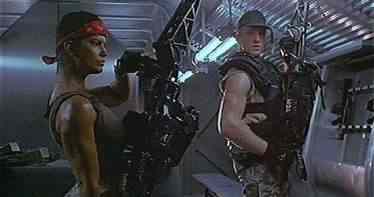
Before I begin, there are two things I’m
going to need to tackle. The first thing is that I actually really enjoy most of director James Macaron Cameron’s output (apart from
Titanic, but that doesn’t mean it will escape comment!). You may have read my outright praise for Aliens in the past. His plotlines and dialogue are elegant and
functional, and the action scenes which drive his movies are hyperkinetic
without being incomprehensible. There’s a lot going on, but he can hold a
camera still for a few seconds rather than chucking it across the room a la Transformers.
The other thing is what misandry is. I’m
sure you’re all familiar with its counterpart, misogyny – the hatred of women –
and all the notions that go with it, such as objectification (treating women as
objects primarily for the pleasure of the so-called ‘male gaze’). Misandry, it
follows, is the hatred of men. What could its possible equivalent to
objectification be? Some people would say that hyper-masculine, hyper-muscular
male figures are there for women to look at, but a Feminist would be partially
correct in dismissing that as a male-manufactured power fantasy. But did you
ever wonder why it’s a power fantasy? Because power gets you laid and,
statistically speaking and apart from socially important lotharios, bigger and
more aggressive men get more girls. Ask yourself, whether you be a man or a
woman, how many women have you met who claim to actively prefer puny or fat
guys? Are you such a woman yourself? Don’t lie, because I’ll know. And I will find you.
The masculine equivalent of objectification
of women – if the argument for it being a problem for women acts as a kind of
denial that it could ever happen to men, which is an utter lie – is something
I’m going to have to semi-invent a term for. That term is ‘agentification’. An
agent is someone or something who actively influences the world around them.
How is this bad? It becomes bad when I offer you the following definition –
‘the treatment of men as agents who act primarily for the benefit and gain of
women’. As with the objectified female, the thoughts, feelings and personality
of the agentified male are considered irrelevant.
Our culture has even had a platitude which
reflects this for hundreds, if not thousands of years – ‘man is defined by his
actions’. It is an attitude so deeply entrenched in our culture that we take it
for granted and it has ceased to be a problem. Think about it – surnames in
most cultures are subject to patrilineal transmission, from father to son. Type
that into spellcheck. Patrilineal doesn’t exist. But matrilineal does. Why is
this? Hmm. I digress. Surnames are patrilineal in most cultures and what do you
notice? Potter. Smith. Farrier. Wright. Turner. And so on. All names derived
from jobs. A man is what he does – not how he thinks or feels. You don’t get
Mr. Sympathetic or Mr. Likesicecream. Of course, if Bruce Wayne had a son,
according to occupation-derivation he would be Mr. Batman, which would give the
game away just a tad. If a man’s surname doesn’t come from his job (i.e it
sounds posh) it is generally an aristocratic derivation referring to some place
his family owned i.e De Montford.
Back to the problem. It is the problem that
makes young men enlist in militaries and die for countries that don’t care
about them. It is the problem that makes men aged 16-24 the absolute
statistically-proven prime victims of violent crime, even though culturally we
harp on about how at risk women are. It is the problem that means that the
human race today is descended from half as many men as women, which means that
throughout our evolution males have consistently been killed off twice as fast
as females. But this is all okay, of course. This is because it is their choice
(although, if they don’t make such choice, they lose their masculine agency and
are less likely to be considered for breeding rights. Evolution, baby). The
notion that this is okay is firmly supported in many of James Cameron’s films –
but in what ways, and why?
I will start with Avatar as the most obvious culprit, and attempt to do it in
summary. At its heart, this movie presents a male-driven military industrial
complex (the baddies) against a female Gaia-type earth-spirit, Eywa (the
goody). The milindust complex is led by the snarky (and physically slight)
corporate bigot Parker Selfridge and the scenery chewing Lt. Col. Miles
Quaritch. The irony is that although Quaritch is nominally the villain, he is
decisive, self-sacrificing and lives up to his word which the ‘hero’ Sully is
largely unable to do. Sully’s main motivations for turning against the military
that employed him? His new blue body lets him walk, and helped him get a hot
blue girlfriend. The hot blue girlfriend part is critical to this discussion.
So how is the above so critical? Sully is
portrayed as stupid, bland and selfish – he betrays pretty much everyone.
Despite constant verbal abuse and disdain from his soon-to-be-girlfriend
Netyri, (“She calls me ‘skown’ which means moron”) he still falls in love with
her. He starts off on the wrong side, and betrays his new blue buddies. What
redeems him? Two things – that he acts upon the instructions of a female
(Netyri) for the benefit of a female earth-spirit, and that (as a masculine
agent) he tames ‘Last Shadow’ which is essentially a huge and deadly pterosaur.
The fact that he is accepted back as a saviour under these circumstances amuses
me – suddenly, all the Na’vi trust him. It is very much like me leaving in
shame driving a Fiat Fiesta and becoming a hero just because I drive back in a
Mercedes Benz. His feelings do not matter, the fact that he is stupid does not
matter, the fact that his motivations are skewed does not matter. He is the hero
because he did something cool to impress a girl.
 |
| Don't laugh mate - you die in 45 minutes' time. |
Let’s examine the other male figures now.
Sully’s main competitor is an arrogant blue dude called Tsu-tey who basically
dares to expect a woman who had already pledged herself to him to be faithful!
What a goddamn crime! How does the movie absolve him of this terrible crime?
Twofold – by having him become subordinate to the ‘hero’ (who is in turn
subordinate to Netyri’s genitals), and die heroically assaulting the bomb
shuttle. The good old disposable male strikes again – Cameron leaves no trope
behind.
 |
| Killed by your own tree, FFS! |
The two tribal leaders can be compared,
too. The patriarchal leader – who wants to kill Sully – is ignobly disposed of
via a spare of wood when hometree is blown to bits, while the matriarchal
figure, who saves Sully (stereotypically nurturing - how ironic) is spared. Ho
hum.
How
do men and women in the milindust complex compare? Little better. All the
background female figures who remain loyal to the army have close-cropped hair
like their male colleagues, while the heroic female pilot (Trudy) who turns
against her employers has lovely long hair. As a strong, assertive man,
Quaritch is put in a position where the audience is not meant to sympathise
with him despite the fact that he’s the only consistent and trustworthy
character with any power in the whole damn film. His female adversary and
equivalent, the scientist Grace Augustine, whose name is just a face-palm
worthy pathetic fallacy, is a total bitch to everyone. But the film tells us to
like and respect her – so a behaviour changes from wicked to respectable
depending on whether a man or a woman does it. In a meritocratic, equal
society, we should judge people’s behaviour, not their sex. Cameron’s hypocrisy
here clearly sees him judging sex. Shouldn’t a (pseudo) Feminist avoid
employing the supposed tactics of the patriarchal enemy?
Anyway, Doctor Elegant Majestic wilfully
pounds down on her subordinates Norm Spelman and Dr Stereotype Patel. These are
the two token consistently loyal and pleasant men in the film, but they are
both portrayed as nervy, nerdy, back-seat taking somewhat asexual blobs. Norm
is even a drooler, apparently as Grace tells his Avatar, “Norm, you’re getting
your saliva in the samples” in response to his lisping dialogue. So, Jim,
you’re saying that we should be confirming the stereotype that nice guys are
chumps, but bad guys can be redeemed if they subject themselves to the will of
a woman while retaining their ability to act and take risks. That’s just
fucking great man – game over man, game over.
 |
| "Not if I kill you first, Jim!" |
Now, on to a summary of how this works in
his other movies. In both Terminator
films, male (or masculine-bodied protagonists such as the T-800 in Terminator 2) exist to protect the
female and her offspring and then die. Kyle Reese gives her offspring, protects
her, then dies. The T-800 gives the thumbs up as he commits suicide or ‘self-terminates’.
As the T-800 is referred to as the ultimate father figure at several points
throughout the movie, the implications are sinister. Mother-of-the future Sarah
Connor says, “watching John with the machine, it was suddenly so clear. Of all
the would-be fathers who came and went over the years, this thing, this
machine, was the only one who measured up. The Terminator would never stop. It
would never leave him. It would never hurt him. It would never shout at him or
get drunk and hit him. Or say it was too busy to spend time with him. And it
would die to protect him. In an insane world, it was the sanest choice”. Ideally,
men are just self-sacrificing machines that exist only to help females and
their young. What they make of it is meaningless. What they feel is moot. But
we are not permitted to see them as victims of agentification.
 |
| He's just DYING to help out! |
The creator of Skynet, Miles Dyson, is on
the other hand a male who neglects his family in favour of his work and needs
to be shown the error of his ways by a woman. He dies redeeming himself in
staying behind at Cyberdyne to detonate the bomb intended to wipe out Skynet’s
future. Can you see a pattern developing here?
In The
Abyss, proto-Augustine superbitch Lindsey Brigman appears and makes a fool
of her ex-husband, Virgil. He makes his transition from immature layabout to
hero only once he accepts that his ex-wife is right about the aliens being
benevolent. The villain of the piece is unsurprisingly a male soldier -but he’s
played by Michael Biehn, so I’m automatically on his side. Corporal Hicks and
Kyle Reese are good-guys!
In Aliens,
Ellen is a mother-figure who essentially adopts the little girl Newt / Rebecca.
Carter Burke, the primary villain, is the proto-Selfridgian corporate stooge.
The nice guys, Corporal Hicks and android Bishop are both horrifically injured
in the service of a woman. They accept this humbly, despite the fact they got
hurt as the result of said woman taking a massive risk (trying to save someone
from alien impregnation) which she had previously disapproved of herself (“You
can’t help them! You can’t! Right now, they’re being cocooned just like the
others”). Yet the risky hypocrisy displayed by Sully is shown to be just fine
when Ripley does it. No-one needs to redeem her – her actions redeem themselves
in the narrative. Granted, it is the only grave error in her otherwise sterling
leadership.
 |
| So Jack and Rose get married and - nah just messin wit ya. HE'S FUCKING DEAD! |
In Titanic, Jack dies to save Rose. Oh
yeah, ‘Women and children first’. I forgot.
All of his men are put-up, shut-up,
define-yourselves-by-your-actions types who become defined as heroes in their
services to women. Self-serving men are villains, self-serving women are
frequently sympathetic protagonists. His films are frequently hypocritical and misandrist
on this level. True Lies is the only
one I can’t figure out.
 |
| Do as I say! Not as I do! |
But why does James Cameron keep doing this
in his films? I don’t think he really believes any of this stuff. It’s all
sinister marketing. Knowing that just making a kick-ass action movie won’t be
enough to bring in the big dollars considering that some – though not all – of
the female audience will be hesitant about seeing it, Cameron essentially
enshrines women in order to put bums in seats. Does he believe in this ‘natural
order’ in real-life? He is on his fifth marriage. Former wife Linda Hamilton,
who ironically played the heroine Sarah Connor in both Terminator movies, is on-record as describing being married to him
as “terrible on every level, he was terribly insecure that I was going to ruin
it for him somehow,”(The Week Uk, March 3rd
2010) and that - in another blazing
irony -implied he was much like Miles Dyson in that he was single-mindedly
focused on his work to the detriment of his family relations. It is also
suspected that he cheated on Hamilton with current wife Suzy Amis. None of this
is secret, libellous or revelatory – just have a look on Google. You can make
your own judgments as to whether he has anywhere near the respect for women he
pretends to have in his films.
What does this all mean? Look at it all
from this angle, and his movies are pick-up artists. These movies are the
sleazy guy in a nightclub who sidles up to a woman and says ‘all these other
guys are horrible. You should sleep with me. I’m nice. I understand. I’ll look
after your interests. Come with me if you want to live’. Well, to paraphrase
the awesome and now sadly perished female-fronted alt-rockers Lush: You say
that women are superior to men? Well, I know the score – and I’ve heard it all
before.
ABOUT THE AUTHOR

David M. Jackson is a lecturer in English
Language and Literature as well as Sociology, so he’s seen your retorts to this
article coming from a mile away and frankly they’re bloody feeble. Don’t even
start – you don’t want to see him get out of this chair.
When not teaching or beaming smugly from
this hallowed webpage, he works on making his ‘about the author’ blurbs
shorter.
By the way, he wrote a novel about a
cybernetically augmented police officer struggling to maintain her humanity
while seeking revenge for her father’s death against the backdrop of civil war
in happy ol’ Britain. It’s called ‘Fidelity, Bravery, Integrity’ - which you
may find a bit ironic. It’s out on Sunday 1st July 2012 via Amazon, priced at £3. Keep your
wallet handy – there’s more to come.