Showing posts with label independent. Show all posts

Tuesday, 3 November 2015

The British Independent Film Award Nominations Are In!

The winners of the British Independent Film Awards will be announced in a ceremony to be held on December 6 in the Old Billingsgate in London.

The nominations were announced today with The Lobster, Macbeth and Suffragette all leading the charge. I've put who I'd like to win so far in bold, but there's quite a few films that I have yet to see on this list including 45 Years, Brooklyn and The Danish Girl so things could change before the awards. Please click any of the titles of the films I have seen for my full reviews.

UPDATE: Winners are now written in large!

Here is the complete list:


Best Actor:

  • Colin Farrell for The Lobster
  • Michael Fassbender for Macbeth
  • Tom Courtenay for 45 Years
  • Tom Hardy for Legend
  • Tom Hiddleston for High-Rise 
This one is really tough but Tom Hardy deserves it for tackling dual roles and for sheer entertainment value.


 Best Supporting Actor:

 I suspect I may be eating my words on this one, once I've seen Brooklyn. 

 Best Actress:

  • Alicia Vikander for The Danish Girl
  • Carey Mulligan for Suffragette
  • Charlotte Rampling for 45 Years
  • Marion Cotillard for Macbeth
  • Saoirse Ronan for Brooklyn
So far I think Mulligan deserves this, but there are three nominees on here whose performances I still need to see.

Best Supporting Actress:

Of the four performances I have seen here, Anne Marie Duff is the clear winner. Really glad to see her nominated.


 Best Director:

This is the toughest category to call. Of the four I have seen, they are all brilliant and well-deserving. I don't understand why Alex Garland isn't in the debut director category as that would make this decision easier. 

 Best Documentary:

  • Amy
  • Dark Horse: The Incredible True Story of Dream Alliance
  • How to Change the World
  • Palio
  • A Syrian Love Story
 I've only seen Amy and Palio, but it's hard to imagine a better documentary than Amy this year.


 Best Debut Director:

  • The Hallow Corin Hardy
  • Kajaki: The True Story Paul Katis
  • Nina Forever Chris Blaine, Ben Blaine
  • Slow West John Maclean
  • The Survivalist Stephen Fingleton
 I've only seen Slow West and The Survivalist, so I'd go with Stephen Fingleton for this one. 


  Best Screenplay:

 I loved Ex Machina and I haven't seen Brooklyn yet. The first half of The Lobster would also be a very worthy winner, but perhaps not the second half. Not sure you can give half a film an award though.


 Best British Independent Film:

Now I think I'm becoming a bit too predictable, but until I see Brooklyn, there is no competition.


 Most Promising Newcomer:

 I've only seen The Survivalist and A Royal Night Out, so again, I stand with Fingleton!


Producer of the Year:

I've only seen Amy and The Lobster, but I suspect Amy was probably the trickier film to get made and a bigger achievement.


 Outstanding Achievement in Craft:

  • Editing - Chris King for Amy
  • Casting - Fiona Weir for Brooklyn
  • Production Design - Mark Digby for Ex Machina 
  • VFX - Andrew Whitehurst for Ex Machina 
  • Cinematography - Adam Arkapaw for Macbeth 
Another incredibly tough category. Macbeth's cinematography, Amy's editing and both the VFX and production design for Ex Machina are all top-notch. Very hard to call.


The Discovery Award:

  • Aaaaaaaah!
  • Burn Burn Burn
  • Orion: The Man Who Would Be King
  • The Return
  • Winter
 This is my category of shame. Not seen a single one of these.


 Best British Short:

  • Balcony
  • Crack
  • Edmond
  • Love Is Blind
  • MANoMAN
 Another category of shame. 


 Best International Independent Film:

Really hope Son of Saul gets this but I doubt it has a chance against Carol.

What do you think of the nominees? 

Thursday, 4 April 2013

The Making of The Blair Witch Project

For my upcoming book on The Blair Witch Project, commissioned for the Auteur Devil's Advocate series on classic horror films, I am currently writing a chapter on the production of the film. It's likely a story you have heard a thousand times before but I've been completely immersing myself in research for the last couple of weeks and finding out more all the time.

The directors Eduardo Sanchez and Daniel Myrick took what they called a 'method directing' approach. The level of improvisation they demanded from their actors Heather Donahue, Joshua Leonard and Michael C. Williams is astounding. The torment, anxiety and discomfort the cast went through while shooting the film is now legendary.


It's got me thinking how many of these Blair Witch imitators these days actually try to achieve a similar effect. Blair Witch was all shot by the stars. I'm sure this is not the case with most other found footage films. I know for a fact films like REC and Cloverfield did not use this technique.

Is this why Blair Witch was so successful? Is the realism created by the production process the reason for its phenomenal success or was it more a case of being the first on the scene to try the found footage thing since Cannibal Holocaust?


I'm reading some fascinating interviews with the stars of Blair Witch in which they go into great detail about what happened on the grueling shoot of the film. To me, it is absolutely fascinating stuff. It's the kind of film I wished I'd made, not just because it made a ton of money but because I love the idea of totally immersing your actors in an experience and making them improvise. The stimulus that the directors provided should have made 'acting' an easier task for the cast. Not having to wait hours for the camera and lighting departments to set up must have been a dream come true for the actors too.


I don't want to reveal all the details of what is in the chapter but suffice to say it's looking like it will be around 5000 words and if you think you know the full story of the making of The Blair Witch Project, then I assure you that it is unlikely you do. I hope you might buy the book when it gets published, hopefully maybe by the end of this year or early 2014!

Thursday, 6 September 2012

Before Midnight Before You Know It!

Here's a new picture straight from the set of the just wrapped trilogy closer Before Midnight, courtesy of Total Film.  Ever since Before Sunset left fans dribbling for more in 2004, people have speculated about whether we would ever get to see Jesse and Celine back together again.

Then today comes the news that not only is the film definitely going to happen, it's already wrapped in Greece and will be hopefully sold to buyers at the Toronto Film Festival which starts today!

Anyway here's the picture.  Look forward to more on this soon.


Read more over at Filmoria.

Thursday, 28 June 2012

Sound of My Voice (Zal Batmanglij, 2012) Review


WARNING: This trailer gives way too many plot details away for my liking.  However my review below does not!  So please read on.


The Sound of My Voice will keep you guessing.
The Sound of My Voice will hypnotise you.
The Sound of My Voice will leave you wanting more.

Indie sci-fi is all over the place at the moment.  Lars Von Trier’s Melancholia imagines the end of the world.  Another Earth features another Earth.  Even Terence Malick’s Tree of Life has big themes like a slightly less trippy 2001: A Space Odyssey.

It’s no surprise then that the writer/star Brit Marling conquered Sundance with not one but two science fiction flavoured low budget success stories in 2011.  On screen, Marling is a blonde beauty with no shortage of acting ability.  Behind the scenes, she is a producer and writer taking smart ideas and coupling them with believable characters and strained romances.


Sound of My Voice is about a cult.  It quickly flips expectations by introducing a character who fits the cult leader stereotype and then revealing him to be second-in-command to Marling’s Maggie who claims to be from the future.  The rituals, tests and routines of the cult are seen from the perspective of newcomers Peter and Lorna as they are initiated.

Beginning with the investigative journalist couple gaining access to the cult, their relationship with each other is tested as well as their belief and scepticism in the enigmatic Maggie.  Is she or isn’t she from the future?  Are her intentions good or evil?  Will Peter (Christopher Denham) be able to resist Maggie’s coercion tactics?   

This is a slow-burn thriller minus many real thrills.  The tension does mount and questions do arise to keep you guessing but unfortunately the film fails to fully fulfil the potential of the intriguing setup.  Towards the end, the introduction of a new character and a suspenseful upping of the stakes threaten to take the film into an action-packed climax.  But alas the climax is a little rushed, a little underwhelming.

The ending is simultaneously closed with no real room for differing interpretations and also abrupt enough to leave the audience gasping for more.  At less than 90 minutes, the film certainly does not outstay its welcome and actually leaves a feeling of being slightly underdeveloped.  A fundamental question is answered convincingly but there are elements that have been left tantalisingly unexplored.

However as an example of what can be achieved with a low budget, interesting characters, very strong acting and a neat narrative enigma, this is inspiring and entertaining independent filmmaking. 


Definitely see this if you liked Another Earth.  Or even the other recent cult-centric indie Martha Marcy May Marlene.  And watch out for Brit Marling.   Whether she’s a time traveller or not, this lady has a bright, bright future.

7 out of 10

Released in the UK on 3rd August 2012 

Seen it?  What did you think?  Anyone desperate to see this?

Thursday, 26 April 2012

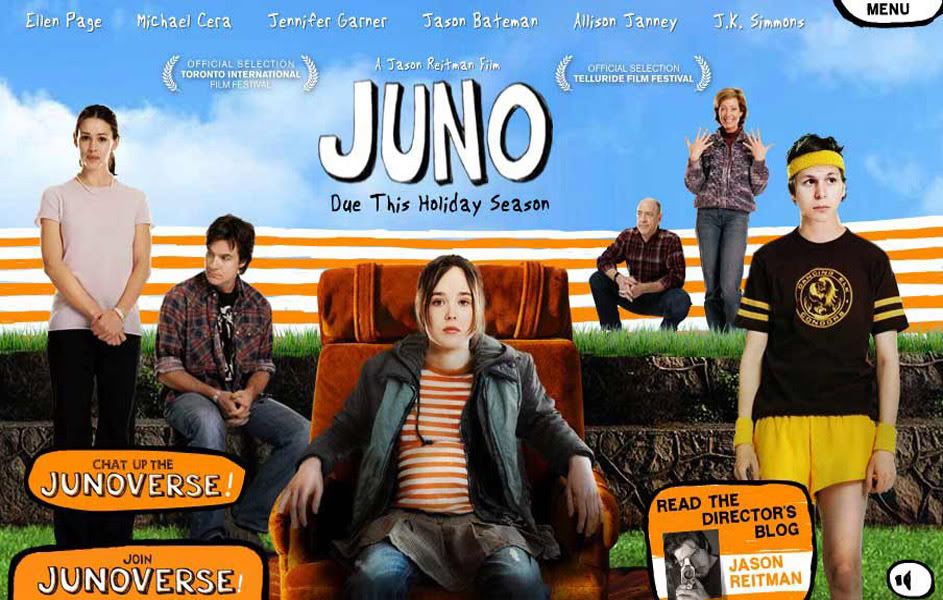
Independent Case Study: Juno (2007)


Over the next few weeks, I will be putting up case studies of Hollywood, Independent and British films to help my A level Film Studies students learn more about the finance, organisation, production, distribution and exhibition of different types of films.  These case studies can be used in their exam when discussing the American and British film industries. This is the third.  The first on Prometheus is here and the second on Attack the Block is here.

Director and writer:

Jason Reitman had only just completed directing Thank You for Smoking but as it was not released yet, he had difficulties acquiring the script for Juno.  He said it was ‘very hard... Thank You for Smoking had not come out yet, so I didn't have much going for me at the time. I was in the midst of finishing Thank You for Smoking, but I didn't have any street cred(ibility) yet’ http://www.movieweb.com/news/exclusive-director-jason-reitman-talks-juno

The script was also written by a first-timer, Diablo Cody.  ‘Before her screenwriting debut Juno received a rapturous standing ovation at this year's Toronto Film Festival, before Steven Spielberg called... Diablo Cody was giving halfhearted lap dances to greasy men at a Minneapolis strip club’ http://www.ew.com/ew/article/0,,20157948,00.html

‘When Jason Reitman, who'd made a name for himself with 2006's Thank You for Smoking, read the script for Juno, he scrapped plans to direct his own project to work with Cody instead. ''When I think of the response to Diablo and her screenplay,'' he says, ''the only person I can equate it to in recent history is Tarantino, that kind of overwhelming excitement about a fresh new voice.''’ http://www.ew.com/ew/article/0,,20157948_2,00.html

Independent film is where a huge amount of talent gets its big break.  Both Reitman and Cody have gone on to more commercial and bigger films since Juno, working with the likes of Clooney in Up in the Air and Megan Fox and Amanda Seyfried in Jennifer’s Body.  Only after Reitman’s first film was a success, did he get the job of directing this feature.  However there were still problems with funding.


Finance:

Budget: $7.5 million

‘There are a variety of methods and many different levels of independent film financing that can range from multi-million dollar backing from major studios right down to personal savings and credit cards of one individual’ http://www.makeindependentfilms.com/financing.htm

During promotion for the film, the actress playing Juno,  Ellen Page, said ‘I read the script a couple years ago -- it was one of those things that takes time [to get off the ground] -- and I fell in love then, but it kind of just dwindled away, didn't have money, so on and so forth. And then it came back around again, and I got excited all over again’ http://www.rottentomatoes.com/m/juno/news/1694026/ellen_page_on_juno_the_rt_interview/

‘the kind of movie Cody wanted to see initially scared off every major studio. ''A lot of people were worried that we would be protested by right-to-lifers or pro-choice people,'' says producer Lianne Halfon of an early incarnation of the project, which was ushered by her company Mr. Mudd... Even after Fox Searchlight greenlit the film, expectations were modest. ''We thought it was going to be a smaller movie because of the subject matter,'' says studio COO Nancy Utley’ http://www.ew.com/ew/article/0,,20175163_3,00.html

The production companies listed on IMDb that financed the film are:
Actor and producer John Malkovich
The involvement of Fox Searchlight demonstrates the modern trend of independent films being made by subsidiaries of the major Hollywood studios.  They take on more challenging and often more complex material but still desire to make profitable films and therefore hope for some mainstream success.  Juno, like so many other modern ‘independent’ films is actually not independent from the major studios and is therefore more independent in terms of its script, characters and story.  A film about a subject like teenage pregnancy is a concern for investors and so funding was hard to come by and expectations for the box office figures are kept low to ensure the film will be profitable.

Organisation:

As early as 1992, Hollywood majors were recognising that in order to capitalise on the potential mainstream success of independent films they needed not only to continue winning the distribution rights to unexpected, alternatively financed hits, but actively seek out the important directors with whom to collaborate. Sony Classics, Paramount Classics and Fox Searchlight were thus created by their respective, internationally co-owned, parent companies to deal with requests for funds. The result of such diversification was that, by the late-1990s, those 'independent' films and film producers winning plaudits were in fact conventionally financed, mainstream pictures; Boys Don't Cry and Election being funded and distributed by multinationals News Corporation and Viacom, with Miramax now a 'major independent' attached to the transglobal Disney corporation. With this, the criteria by which art-house films were marketed and exploited was also fundamentally changed. Higher budgets, increased advertising and wider platform releases all brought the 'independent' sector closer to the high stakes movie-making of the commercial cinema than ever beforehttp://www.thefilmjournal.com/issue6/americancinema.html

Today, every major film studio has specialty departments designed to create offbeat, smart contenders for the awards. They typically are films with modest budgets (usually less than $50 million) and limited promotion — at least initially.

In essence, such films are orchestrated to start off as word-of-mouth favorites among devoted moviegoers. As a result, they can wind up as Academy Award nominees with relatively few people having seen them’ http://www.usatoday.com/life/movies/movieawards/oscars/2008-02-21-oscar-box-office_N.htm

These quotes highlight the studios’ dominating of the independent sector in recent years.  They use their subsidiaries such as Fox Searchlight to make smaller films that can make big money thanks to festivals, competitions and awards.


Production:

‘Many independent producers don't watch the market for trends and analyze what movies they are competing with. They simply make a film and put it out. Studios have marketing departments and develop strategies for the best times to release a film’ http://voices.yahoo.com/analysis-2007-independent-film-box-office-numbers-1848390.html

‘To keep to the budget, high profile stars like Jennifer Garner took cuts in their usual pay’ http://www.cbsnews.com/stories/2008/02/09/sunday/main3812797.shtml

This happens a lot with independent films.  See also Pulp Fiction.
‘Reitman, whose wife, Michele Lee, is from Vancouver, specifically wanted to film here after having worked here on TV commercials, and not because he was told to for budgetary reasons’ http://www.canada.com/theprovince/news/etoday/story.html?id=4462e21d-ef83-4405-bc6a-e50cb1a578e5

"at the time there was a great deal of excitement about Jason Reitman. When we were just going into production he was being nominated for a Golden Globe. Lots of people were very interested in being a part of it. It was a very modest budget, so a lot of people were working for lower rates. Not low, but lower, and they had tight budget constraints and they did fantastic jobs." http://www.canada.com/reginaleaderpost/news/arts_life/story.html?k=11507&id=388a098f-854a-439f-a0c8-1c90da0eb7b0


Independent films typically have short shooting schedules and do not use the latest and most expensive technology such as CGI, Imax and 3D.  They do often feature stars but these stars often take pay cuts to appear in what they think will be critically adored and popular films.  It is shot on locations rather than in expensive studios with built sets.


Stars:

‘Ellen Page starred in the controversial film "Hard Candy" and appeared in "X-Men: The Last Stand". "Juno" is a reunion of sorts for Jason Bateman and Michael Cera, who both starred in the acclaimed Fox comedy "Arrested Development." Jennifer Garner starred on ABC's "Alias" and is known for such films as "13 Going on 30." Olivia Thirlby recently starred in David Gordon Green's Sundance hit "Snow Angels." JK Simmons played Nick Naylor's boss in Reitman's hit "Thank You for Smoking." Allison Janney starred on NBC's "The West Wing" and will soon be seen in the upcoming movie musical "Hairspray." Rainn Wilson plays Dwight on the NBC hit series "The Office."’ http://www.jeremywalker.com/pages/films/film_juno.htm#

‘On the teen appeal front, there’s Superbad‘s own supersensitive Michael Cera, presciently cast as the nominal male lead to the film’s obvious breakout star, Ellen Page (X-Men 3; Hard Candy)’ http://popwatch.ew.com/2007/09/04/telluride-day-4/

Lots of the stars here are famous from television and less so from feature films.  This can be typical of independent films that often do not have the budgets to afford the biggest stars.  However the stars they do get will help the film to cross over into the mainstream and be a draw for audiences to see the film.


Distribution:

‘A slow release (what most indies use) is to release on a limited number of screens in a few key markets and hope word of mouth drives up ticket sales. Then they will expand it (increase screen count) as ticket sales increase. The advantage is that it keeps P&A (prints and advertising) costs to a minimum’ http://voices.yahoo.com/analysis-2007-independent-film-box-office-numbers-1848390.html

The best movie of 2007 is coming to theatres 9 days earlier than expected. The film, Juno, directed by Jason Reitman was originally scheduled to hit theatres on December 15th, but has been moved up to take advantage of all the incredible advance buzz.  Juno will now hit theatres on Wednesday, December 5th in New York and Los Angeles, and will expand on a platform release in the subsequent weeks’ http://www.slashfilm.com/junos-due-date-sooner-than-expected/

"Juno" will open in an additional 13 cities on Friday, upping the total theatre count to about 40. Another 17 cities will be added on Dec. 21, and the film will further expand on Christmas Day before going nationwide Jan. 4’ http://www.variety.com/article/VR1117977409?refCatId=13

In the film, the protagonist Juno talks to her friend on a phone shaped like a hamburger. It’s a charming illustration of her quirky character, and there’s even a joke about it in the script.
The producers of Juno apparently sent a hamburger phone to journalists to entice them to review the film’ http://www.friendswithbenefitsbook.com/2008/01/27/great-movie-marketing-and-a-hamburger-phone-from-juno/

‘Paul de Carvalho, manager of Fox Searchlight in Australia, said the studio brought 100 Juno-branded phones to Australia for use in promotional giveaways’ http://www.theage.com.au/news/technology/junos-hamburger-phone-sparks-online-sales/2008/02/06/1202233932553.html

Distribution for this film is very different to most Hollywood blockbusters.  The film starts out at festivals and on a limited number of screens.  As buzz builds and word of mouth spreads, the film gets a wider release.  It is also released at a time when it is likely to get attention in the awards season.  The marketing is quirkier and less traditional than Hollywood blockbusters.  Note also that the posters and trailers emphasise the critical response to the film and the awards it has won.


Exhibition:

‘There are numerous reasons why indie films have small success. One of which is the number of screens they are released on. A typical studio wide release is 3000 plus screens. The Dark Knight was released on 4366 screens1. Most indie films are released with very small screen counts; many times only on 3 to 5 and sometimes a couple of hundred. If an indie gets a wide release it is usually because it already has some buzz. For instance Hostel 2 opened on 2350 screens but it was a sequel to a film that was a huge success’ http://voices.yahoo.com/analysis-2007-independent-film-box-office-numbers-1848390.html

‘In 2006 Little Miss Sunshine was opened on 7 screens in late July. Within 2 weeks it was expanded to 58 screens. Toward the end of August it began to get Oscar buzz and was expanded to 1602 screens. Of course Little Miss Sunshine went on to win 2 Oscars which helped its theatrical run that ended in March 2007. Although it is not typical for a small indie film ($8M budget) to do this well ($100M+ worldwide gross) it does happen using the slow release’ http://voices.yahoo.com/analysis-2007-independent-film-box-office-numbers-1848390.html

‘"Juno," playing in seven theaters in Los Angeles and Gotham, scored a boffo per-screen average of $60,016, one of the best on record for that number of theaters and outperforming the openings of previous Searchlight hits "Little Miss Sunshine" and "Sideways."’ http://www.variety.com/article/VR1117977409?refCatId=13

‘Fox Searchlight... recently made the decision to start rolling Reitman’s film out on December 14 — which, as screenwriter Diablo Cody ... says on her blog, "is not a messin’-around release date. It’s kind of a scary release date. It’s a we-believe-in-you release date”... The studio’s optimistic judgment call on that release date may not represent a sure Oscar-bait belief so much as an "everybody in the family over 15 will have a good time and go home hating each other less at Christmastime" kind of thing’ http://popwatch.ew.com/2007/09/04/telluride-day-4/

 ‘Juno has become a massive crossover hit, sailing past $100 million and landing Academy Award nominations for Best Picture, Best Actress, Best Director, and Best Original Screenplay. The Best Picture race may include such high-pedigree contenders as There Will Be Blood, Michael Clayton, No Country for Old Men, and Atonement, but little $6.5 million Juno has surpassed them all’ http://www.ew.com/ew/article/0,,20175163,00.html

Total Lifetime Grosses
Domestic:
 $143,495,265
   62.0%
 $87,916,319
   38.0%


Worldwide:
 $231,411,584


Juno has been incredibly successful for an independent film.  This is due to a clever script and great characters but also due to a clever distribution plan that has seen it embraced by a mainstream audience.

That's Juno in a nutshell and also hopefully a bit of insight into the state of modern American independent film.