Showing posts with label kill bill. Show all posts

Thursday, 24 December 2015

Before The Hateful Eight: A Quentin Tarantino Retrospective


No director in recent history deserves his name to become an adjective as much as Quentin Tarantino. One of the most controversial figures of modern American film emerged from video store geek to Sundance sensation with his both unique and familiar take on the crime film, and immediately ‘Tarantino-esque’ was coined as an exciting way to describe a slew of (often less than exciting) imitators influenced by the new director. Now Tarantino is back with what promises to be a bit of a return to his roots with The Hateful Eight looking a bit like a Western version of Reservoir Dogs.

Dabbling in genres from samurai and kung-fu flicks to historical war films, Tarantino has a definite style, numerous trademarks and a love of cult cinema that shines through in every screenplay. A writer and director often criticised for the levels of violence in his films, he is an auteur unafraid to court controversy. From sadistic bank robbers to sadistic Nazis, Tarantino’s movie worlds are littered with low-life scumbags that make life miserable for other characters.

Tarantino has been known to divide critics, filmmakers and audiences with his vicious violence, repeated racial epithets and the odd accusation of style over substance. Spike Lee called him ‘infatuated’ with the ‘N’ word after its regular use in Jackie Brown (1997) and notable uses in his previous two films. The BBFC decided to pass Reservoir Dogs (1992) uncut but only after much debate over an infamous torture scene. His later films like Death Proof (2007) and Inglourious Basterds (2009) have received somewhat less critical adulation than his earlier, more startling and fiercely independent works.

Reservoir Dogs, released in 1992 is the genre defying debut of an ambitious young video store geek burning to show his skills as both writer and director. It features a cool cast including Harvey Keitel, Tim Roth and Steve Buscemi, buckets of blood and in the middle of it all; joker Michael Madsen dancing, ear slicing and ensuring the film a place in cinematic history. Inspired by the likes of The Taking of Pelham One Two Three (1974) and its colour coded criminal names, Kubrick’s The Killing (1956) and its fractured narrative structure and from further afield Ringo Lam’s City of Fire (1987), whose final act it virtually steals wholesale; it breaks the fundamental convention of a heist film. By barely showing the actual robbery and only the fallout, it focuses on characters including Tim Roth’s undercover cop and Madsen’s cold blooded psychopath and fizzes with energy, wit and bloody sadistic violence.


Only two years later, Tarantino returned with Pulp Fiction (1994), his undisputed masterpiece. Borrowing liberally from French New Wave influences such as the films of Godard and Truffaut and telling three stories linked only by gangster Marcellus Wallace, it is a tour de force of film making; stylish, sexy, swear-y and sickening. Samuel L. Jackson makes his first appearance in a Tarantino film beginning a long collaboration that continues today. Never has Tarantino’s dialogue flowed as richly as between the similarly clad gangsters to Reservoir Dogs' characters, Jules and Vincent. And never have Tarantino’s monologues been so juicily delivered as Samuel L. Jackson’s iconic delivery of Ezekiel 25:17. The non-linear narrative, brutal violence and chapter titles crystallised, confirming Tarantino as a unique director, borrowing continually from his cinematic heroes and creating memorable and original works of crime fiction.


He then adapted Elmore Leonard’s novel Jackie Brown into an infinitely more mature, but less stylish and snappily scripted homage to Blaxploitation films of the 70s. It bears all the marks of a director comfortable in his new shoes as the king of independent cinema, constantly imitated but never bettered. There is less showing off here; no memorable monologues, a mostly linear structure and a move away from the regular appearances of Tim Roth, Harvey Keitel, and Steve Buscemi that had featured in Tarantino’s films so far. Pam Grier, Robert Forster and Robert De Niro all appear with Samuel L. Jackson returning as another ruthless criminal. It may bear less of the Tarantino-esque trademarks but it still stands as a classic crime caper, clever and assured filmmaking, and a wonderful homage to films that influenced Tarantino.


Kill Bill Volumes 1&2 (2003 and 2004) are the first of Tarantino's foolishly split double bills. Originally meant to be one film, a decision was made by Tarantino with most likely a great deal of input from Harvey Weinstein to cut the film down the middle and unfortunately turned one roaring rampage of revenge into two volumes that decreased in quality as a result. Kill Bill Vol. 3 might be alive and possible according to the most recent reports, no doubt due to the original films having a lot of fans with their samurai-flavoured, Shaw brothers inspired bloodletting. Owing a considerable debt to Lady Snowblood (1973) which provides a template for The Bride’s story of vengeance, it is filled with references to little known kung-fu films and proved that Tarantino was a director as comfortable with fight scenes as with dialogue. The pair of films also marked his second collaboration with his muse Uma Thurman after her iconic part as Marcellus Wallace’s moll in Pulp Fiction.


If Tarantino’s career could be divided up into chapters like one of his films, there would certainly be a chapter called “The Rodriguez Situation”. Best buddies Tarantino and Robert Rodriguez joined forces on iffy anthology Four Rooms (1995), directing separate episodes in the odd collection of stories centring on Tim Roth’s hotel bellhop. Tarantino later guest directed a scene in Rodriguez’s Sin City (2005) before the pair officially collaborated on their Grindhouse (2007) double feature, directing one film each to be marketed and screened as one cinematic experience.

Tarantino’s Death Proof suffered in comparison next to the gloriously gory thrills of Rodriguez’s Planet Terror but still has Kurt Russell as a stunt driving psycho and a fierce car chase that puts stunt woman Zoe Bell (Uma’s stunt double in Kill Bill) right where she belongs; wriggling around on the bonnet of a speeding car being slammed by Kurt Russell's death machine. Death Proof deserves the style over substance accusation of many of Tarantino’s films but the physically scratched image is wonderfully grimy and though it is completely chronological, it still features plenty of typically Tarantino-esque dialogue. Americans got to see the double bill as intended complete with fake trailers in the middle. However Britain got shafted again by the money men with another terrible decision to release both films separately.


Inglourious Basterds was a serious return to form for Tarantino. It is another blood thirsty tale of revenge and the first of what could potentially become his historical trilogy. Mixing biggest-star-in-the-world Brad Pitt with up-and-coming actors like Michael Fassbender and introducing English speaking audiences to the majesty of Christoph Waltz, it is possibly Tarantino’s most brutal and bonkers creation. Waltz’s Colonel Landa is another of Tarantino’s ingenious creations, a smooth-talking sadist who is as comic as he is hideous, almost as over the top as the astonishingly violent cinema-set climax. Nazi’s hunt Jews, Jews hunt Nazi’s and Hitler appears only long enough for Tarantino to completely rewrite the history books.


Django Unchained is a typically brutal and sadistic look at slavery in the South. Samuel L. Jackson reappears, Tarantino takes another small role as in many of his previous films, and Leonardo DiCaprio joins Tarantino’s memorable list of sick and twisted nasty bastards. It's a tough watch; both funny, cathartic and occasionally unbearable.

Untouchable Tarantino can work with anybody he chooses. From the moment he caught Keitel for Reservoir Dogs to snatching John Travolta and Bruce Willis (at career low points) in Pulp Fiction, Tarantino has a knack for canny casting. His collaborations with Samuel L. Jackson, Uma Thurman and most recently Christoph Waltz have proved that he is a dream director to work for, despite apparently strangling Diane Kruger on the set of Inglourious Basterds. Ticking off two of the biggest and best males stars in Pitt and DiCaprio, he has confirmed that he and Johnny Depp wish to work together one day in the future. Promising to retire at 60 after a couple more films, we must savour every drop of Tarantino that he has to offer, with or without Depp.

So what is Tarantino-esque and why has it become such a commonly used word for cool characters, cooler dialogue and quality filmmaking; both cult-inspired and mainstream-influencing? His soundtracks are slick hand-picked play lists; his casts revive the careers of has-beens and introduce bright new stars and his ripping off of obscure cult cinema creates fitting homage to little seen movies. His worlds are filled with furious revenge fantasies, sadistic violence and shot through with distinctive style. From out-of-the-trunk-of-car shots, non-linear narratives, occasional uses of black and white to his foot fetish and corpse eye view shots, Tarantino is recognizable from his films' stylistic flourishes as much as his monologues and often dazzling dialogue. His influences are many; he is a cinematic magpie, taking from what he pleases, unchained by genre conventions and creating something new from the old. His impending retirement is just another reason to revisit his cinematic oeuvre ahead of The Hateful Eight’s UK release on 8th January 2016.

Thursday, 17 January 2013

Director Retrospectives: Part 1 Quentin Tarantino

Ahead of the some of the biggest and best film releases of 2013, Filmoria have decided to do a retrospective of each director's work. We all got to choose six directors who have films being released this year and the idea is that in the week leading up to the new film, we will write and publish a retrospective look at that director's body of work.

I got to pick six fantastic directors, some of my very favourites and others who have enough significant films to make their body of work worth revisiting for me. I take tasks like this very seriously and would like to get through all the films of each particular director before I write the pieces. Fortunately and unfortunately I got Quentin Tarantino as my first director. Fortunately because I've seen and own nearly all of his films and am looking forward to Django Unchained but unfortunately because I had just over a week to prepare my piece for Filmoria and re-watch the films.


I wanted to re-watch all his films before writing but couldn't get hold of Reservoir Dogs or Death Proof in time. I ended up buying Natural Born Killers and True Romance instead as Tarantino wrote the screenplays but am not including them in my feature. I haven't seen either for a very long time and am looking forward to catching them again.

Anyway I don't want to give away the other directors I am doing in this series suffice to say that I am really looking forward to writing more pieces on some very exciting and interesting directors. I will add links as the year goes on and I write more of the director retrospectives. The next one I am doing will be in March is one of my absolute favourite directors. I'm going to start re-watching his films this week in preparation.


For now, here is my look at the career of director Quentin Tarantino so far. It took a lot of time and a lot of research so please give it a read if you're a fan of his work... or even if you're not!

Other Filmoria writers have recently tackled:

Steven Soderbergh
Walter Hill
Kathryn Bigelow
Judd Apatow
Robert Zemeckis

Your comments are always welcome... what do you think of Tarantino?

Thursday, 3 January 2013

The Hobbit: An Unnecessary Trilogy


If only I had as much writing talent as Peter Jackson has filmmaking talent. Then I could make all you readers sit through a three part review of The Hobbit: An Unexpected Journey and love almost every minute of it. Even if it was bloated, meandering and perhaps a little pointless splitting it into three parts.

I finally saw The Hobbit last night at the cinema and I must say I was a bit fidgety, particularly in the first forty minutes before the unexpected journey actually begins. Despite this, it has made me want to re-read the book if not just to see how much Jackson has added in himself.


I’m still angry with Tarantino for what he did to Kill Bill. I really didn’t think Kill Bill Vol 2 worked very well whereas I loved every minute of Vol 1. If he had just kept it as one film, I would probably have loved the whole a hell of a lot more than I loved these two separate parts. As soon as I heard about Jackson splitting The Hobbit in two I was very dubious but then to hear he was splitting it into three seemed laughable.

I loved the Lord of the Rings Extended Editions as much as the next Tolkein fan but that was after I had fallen in love with the original well-paced films in the cinema. Watching The Hobbit felt a bit like watching an extended edition that we hadn’t asked for yet. There were many scenes that felt like they belonged on the cutting room floor and that perhaps one day in the future it would be enjoyable to see on a special edition DVD.


That said it’s still a brilliant piece of filmmaking and there is no doubt I’ll be seeing the next two. But I do wish Peter Jackson had gone for a leaner version. The Hobbit would make an excellent single film I’m sure. And I wonder how kids have managed to sit through this first part of the journey. I read reviews saying it was more kiddy-friendly with all the dwarves making it comical. But that running time was making my mind wander. There were so many scenes that will take all three films to realize their true meaning and value I suspect.

Without a doubt, the most brilliant thing about the Hobbit was the return of Gollum. To all the people I hear slagging off Lord of the Rings, I would argue that no matter what they think about the endless battles, the endless walking and the infinite characters with confusing names, Gollum is the reason to love these stories. He is the character that stands above them all; utterly tragic, convincing and played to absolute perfection by Andy Serkis and the incredible effects work of WETA.


The riddles in the dark scene was perfection. The genesis of all Gollum’s troubles and the entire Lord of the Rings trilogy is here. Like the scene that opened The Return of the King where we leaned how Smeagol found the ring in the first place, this was completely devastating and immediately made me want to re-watch the LOTR trilogy. Gollum is completely sympathetic and the tragedy of his story all came flooding back when he appeared out of the darkness. Martin Freeman and the dwarves never had a chance of stealing this film from the real star. Although I must mention Cate Blanchett as Galadriel who  managed to give a potentially dull scene more spark.

The Hobbit Parts 2 and 3 will have a huge task in making me forget Gollum and I only hope that Smaug will be a memorable villain who might be able to do the trick.


Let me know what you thought in the comments below.

Thursday, 18 October 2012

Feminist Analysis of Terminator 1 and 2


 Here's a look at the first two Terminator films taking a feminist approach.  This is for my BTEC Film Studies students who are currently writing up their own feminist analysis of science fiction films which I hope they will then turn into a blog post just like this!  It follows from yesterday's genre analysis of The Terminator.  Enjoy reading and please leave any feedback if you have anything to say about what has been written here.  After reading this, you may also find it interesting to read David Jackson's piece on why he thinks James Cameron is misandrist. 

The icon returns... as the good guy!
Feminism is a movement that began in the early 20th Century with the purpose of creating equal rights for women.  At this point, women were not allowed to vote and had very little opportunities for employment or even control over their own bodies.  Women were virtually possessions for their husbands and domestic violence was even more common than it still worryingly is today.  Feminists argued for women’s right to vote and for equal rights with men in the workplace and in the home.  They were advocates for methods of birth control becoming available so women could take more control of their own bodies.

Feminist film theory is important because films are such a popular and influential medium.  Feminist theorists are particularly concerned with the role of women in films and how they are represented.  They analyse films from a feminist perspective, looking specifically at the development and empowerment of women in narratives, the relationship between female characters, the male gaze and the idea of containment of women.

Help!
In The Terminator, Sarah Connor is firstly represented as a stereotypical damsel in distress figure.  She is the princess that needs to be rescued from the evil villain by a heroic male figure.  Kyle Reese is a soldier sent back from the future to protect Sarah from the Terminator.  Sarah is represented as a weak woman and she is employed as a waitress but finds it difficult as she is disrespected by the customers.  When the Terminator finds Sarah she is scared and feeling hunted as a strange man has been following and watching her.  This turns out to be Reese who than saves her by shooting at the Terminator.  Sarah is dragged around by Reese who continually saves her from death.  He is the character with knowledge in the story and he has to repeatedly tell Sarah what is going on.

Man strong, woman weak
As the story progresses, Sarah learns how to defend herself a bit more.  The male character teaches her to make bombs and how to use weapons.  Sarah is dependent on the knowledge and skill of the male character.  By the end Sarah has become the final girl, like in many slasher films as her protector has died trying to save her.  Even before his death, Sarah has become stronger and when Reese is injured she is the one that encourages him to keep going.  Finally when Reese dies, after injuring the Terminator, Sarah must fight back and gain her independence.  She crushes the Terminator despite her injury.

Literally contained
In Terminator 2, Sarah has been institutionalised because figures of patriarchal authority such as the police and doctors believe she is crazy. This is an example of containment.  Sarah is now a strong, independent woman and she has been locked up in a mental institution for it.  Sarah is first shown as strong and in control of her body and surroundings.  She has turned her cell into a makeshift gym so that she can do chin ups.  She is watched by a team of doctors like a dangerous caged animal.  She is resourceful and intelligent and almost escapes the hospital without any help.  When the Terminator arrives with her son, she is briefly relegated again to the damsel in distress role.

Tooled up
However throughout the film, Sarah is tough, good with typical masculine weaponry such as guns and determined.  Increasingly she becomes more dependent on the Terminator as he is stronger and virtually indestructible.  In the final scene where Sarah confronts the villain, it is the ‘male’ Terminator who must finish the job when Sarah runs out of bullets.  Therefore Sarah’s position in the film becomes less prominent as the male characters become increasingly important.  On a few occasions she is actually a hindrance to the mission and has to be told to calm down and remain focused by her ten year old son.

Feminists would find the representation of women in the film to be progressive in the lack of a male gaze set up in the films.  The idea of the male gaze suggests that women are often objectified and sexualised by male screenwriters and directors.  Women are often filmed to emphasise their attractiveness to the male audience and the viewer is often positioned to look at women as if they are a male character staring at the woman’s body.  Sarah Connor is never a sex object, although in the first film there is a sex scene where her bare breasts are visible.  However for the most part, especially in the second film, Sarah is not dressed in sexualised clothes and the camera does not linger on her body or her appearance.

The male gaze
On the other hand, in Transformers and the sequel, Mikaela Banes is played by Megan Fox and is constantly dressed in revealing clothes such as short skirts and tight tops.  Though she is quite a strong character who displays knowledge of car mechanics and gets to fight alongside the heroes in the final battle, she is also objectified as she leans over a car and then a motorbike in the sequel.  The camera tilts up her body showing us the reaction of the male character as he looks at her.  The audience is invited to identify with the male hero as he enjoys the look of the female character.

The Fox
The notion of containment is also central to feminist film theory.  Often strong female characters have to be contained by the men who write and direct Hollywood films.  Even though Thelma and Louise for example try to break free of social norms, they have to kill themselves at the end of the film in a last act of defiance.  Similarly strong women are often contained by the patriarchal idea that they must be mothers.  In films from Kill Bill to Aliens to Terminator 2, the female heroes of the story are strong because they are protective of their offspring or because they take the role of a surrogate mother.  Sarah Connor is only important because she gives birth to the leader of the human resistance in the films.  Her role as mother is the most important thing about her.  She is fighting to protect her son John Connor so that he can grow up to save the human race in the future.  Her caring nature as a mother figure also means that she fails in an assassination attempt later in the film.  When a child pleads with her to not kill his father, Sarah breaks down and cannot continue in her actions.  Again, she is saved by the male characters that come to help her.

Mummy you're so badass.
This is a common way for screenwriters to assert patriarchal ideology over strong female characters.  Sarah Connor is also literally contained at the start of Terminator 2 because she has tried to fight the system and figures of authority have deemed her insane.  She is even licked by a male nurse as a reminder to the audience that she is a woman and therefore vulnerable and targeted by men.  However it is only with the help of male characters that she can break free of this containment.

Kicking ass for kids.
From looking at the Terminator films, it is clear that feminism has had an effect on the narratives and ideology of many Hollywood films.  Science fiction of the 1950s did not have tough female characters as heroes and the damsel in distress was a far more common character type.  Women were much more likely to scream and run and be the victim of the villain whereas Sarah Connor shows resourcefulness, intelligence and some independence and strength.  Many female heroes are still objectified such as in Tomb Raider and Resident Evil but there are more progressive roles for women in action, horror, and science fiction cinema than there used to be.

Can I get a hug?

Wednesday, 27 June 2012

Why I Love That Film: Aliens


Ladies and gentlemen!  May I present to you I Love That Film's very first guest post from a fellow writer and teacher, David Jackson.  Here's why David Jackson loves Aliens:


In all honesty I feel that this review is moot; why I love Aliens and therefore why everyone else should love it is self-evident and can be summed up in the following three words:

It’s fucking great.

Though every last letter of that pronouncement is wholly true, the horrible realisation has dawned upon me that there are people on this Earth who have not seen Aliens. Those who have an excuse – the absence of running water, let alone DVD players – notwithstanding, this situation is unforgivable. It is a situation almost as unforgivable as the fact that there are people alive on the verge of adulthood who are younger than that other great James Cameron movie – Terminator 2: Judgement Day.
 
Before I get into highlighting the fact that only three of my students have seen any of the Back to the Future trilogy and one of them claimed they ‘were rubbish’ (and has since been committed to psychiatric care), I should resume reviewing Aliens. The topic of the death of culture itself can wait.

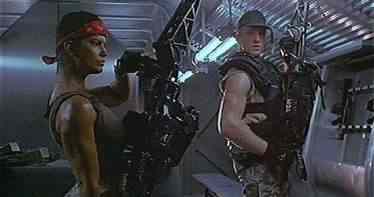
For the uninitiated, Aliens  is the 1986 follow-up to Ridley Scott’s uninventive but flawlessly executed Alien, and concerns the PTSD-afflicted Ellen Ripley’s ill-fated attempts to investigate (with the assistance of gum-chewing soldiers) the disappearance of an entire colony of humans on the planet where the titular phallus-bonced xenomorphs were originally found.


There are so many reasons to love this film from an aesthetic and technical point of view. Aside from the despicable haircuts, it’s hard to place it as a 1986 movie – a testament to the excellence of a production put together on (even then) a mediocre budget of eighteen million dollars. The academy award winning practical and special effects still equal those of any CGI-driven blockbuster of today, and even the slightly phony rear-projection face-offs with the Queen in her nest towards the end of the movie are more convincing than watching Ryan Reynold’s head floating against a background of pixellated green mush. The central character of Ripley is portrayed within a believable Feminist framework that is rare today. It is an action movie. It is a horror movie. It is a cyberpunk commentary on the dangers of unlimited corporate power. It’s even a serviceable Vietnam War allegory. To cover it all would require an entire book.

I remember seeing snippets of Aliens at a young age and finally saw the director’s cut in full aged fourteen when the boxset was released on VHS in 1997 before Alien Resurrection came out and ran head-first into a brick wall. What impressed me most was the design of the Colonial Marines’ military hardware – it was both futuristic and grounded within a recognisable practical reality. The designs are so cemented in the collective geek imagination that it they have been knowingly and smirkingly assimilated into other media. The UNSC troops and vehicles in the legendary Halo videogame franchise are the clearest example. Even Sergeant Apone makes an appearance in them under the guise of Sergeant Johnson.

One thing that is brilliant about the use of military hardware from a narrative point of view is that it underlines the menace of the xenomorph threat itself. The Colonial Marines are over-equipped to the point of complacence. Their weaponry is in fact overpowered to the point of liability – it indirectly results in the destruction of the colony they set out to save. One message of the movie is clear – flesh is stronger than steel. As an allegory for the trials of the US during the Vietnam War, it serves to illustrate how the superior numbers, guerrilla stealth and almost fearless nature of the North Vietnamese were more important than all the high-explosives at the Americans’ disposal.


Characterisation is a strength of this film – oddly because it doesn’t try too hard. The heavily-armed ready-meals who populate this film are painted with broad but memorable strokes. Sometimes, the best icons are the simplest. What really matters is the character of Ripley herself and how she is used to deftly handle second-wave Feminist issues in the script by Cameron (and some extent Alien screenwriters Giler and Hill).

Summary of powerful female characters in a modern film: take the recent Salt or maybe Tomb Raider (Jolie coincidence? I think not) or even the horrendously overrated marathon pop-video wank-fests known as Kill-Bill parts 1 & 2. Their approach is ‘because I am sexy, I am powerful’. Supermodel physiques that in reality can barely pull back the bed-sheets in the morning pull off feats of superhuman strength and speed far outclassing the obviously physically-fit male counterparts of these movies. I see this and I’m immediately bored. Why is it that their power has to be linked to their attractiveness in the most conventional terms? Why do we need to define female characters by their sexuality at all?

Aliens eschews all this and gives us in Ripley a character with powerful biological drive in terms of mothering instincts,  and assets that are universally praise-worthy in anyone. She is pragmatic, determined and cool-headed. She isn’t given any super-strength or inexplicable martial arts skills and the justification of her place in a masculine hierarchy certainly isn’t centred on her appearance. Surrounded by gung-go troops, an incompetent combat-virginal Lieutenant and a slimy corporate executive, she uses her experience and ingenuity to help the group survive. Some people might criticise Ripley, in her leather jacket and blue overalls, as being a character that’s essentially neutered. They might also argue that the loss of her own child and subsequent near-suicidal attachment to the orphan Rebecca (also known as Newt) are simply concessions made to give her a traditional female grounding. 


What is important here is that is we are dealing with the female not the feminine. Her biological leanings are inescapable and provide drive without defining her means of success. Other characters in the films mentioned above are defined in terms of the feminine – the artificial, socially contrived characteristics associated with females but which (though we get confused in our culture) have nothing to do with the essence of being female or even human. In short, the abilities that Ripley displays can be believed. There is a clear relation between her outward presentation and behaviour and what she achieves. She’s not even the ever-pouting super-bitch that is commonly portrayed as being the kind of woman who excels in a ‘male’ environment. Ripley is tough, but sensitive in quite a straightforward, undecorated manner. In other words, a great leader.

Unsurprisingly, another area in which Aliens excels is in its action ... or should we be surprised? If you added together all the action sequences from the 137-minute director’s cut, you probably only get about 35 minutes of action. In these scenes, the xenomorphs themselves are seldom in the same frame as the Colonial Marines and there are long moments of fighting where the aliens aren’t shown at all. Far from being simple cost-cutting exercises, these are strategies that make the action work. Marines blast away at middle-distance off-camera threats because they are in a confused situation and attacked by almost invisible enemies from all sides. Constant cuts to their out-of-depth Lieutenant watching their decimation from camera feeds enhance the sense of helplessness. Snap-cuts to creatures being mown down by sentry guns in a dark corridor give the impression of the beasts being innumerable even though we are only shown a few being involved at any time.

The sense of action, in short, relies on atmosphere for its thrill and menace. This is not a ‘literal’ action film that shows you everything in candid, realistic detail. The lighting in particular plays a crucial role. In one set-piece, the aliens make their way around the Marines’ barricade and into the Operations Centre by crawling under the floor and over the ceiling grates – but not before cutting the power. Cutting the power of course results in the engagement of emergency lighting which saturates the scene with murky blood-red tones that underline the primal horror of the moment, create a tantalising half-light which makes the creatures more threatening and serves as pathetic fallacy for the turning point wherein there is no hope for survival. During Ripley’s rescue of Newt and her final duel with the Queen, strobing hazard-lights create a tense visual heart-beat.


Aliens is fantastic not only as a stand-alone film but as a sequel. It isn’t the simple ‘more expensive version of the original’ approach taken by many films (though it did cost more). It operates on an entirely different dynamic and unravels some of the more mysterious elements of the original in a logical way. The nature of the xenomorph is expanded upon with the exposition of a hive hierarchy, and their survival strategies adapt when the conditions of their human enemies change. Expectations set up by the original – such as that all androids are untrustworthy tools of the evil Weyland Yutani Corporation – are toyed with and then smashed.

In summation, Aliens is a movie that has aged well. It has clever direction, sympathetic and believable spins on classic stereotypes, and stunning production design. It is a movie-geek’s dream as well as a satisfying mainstream action-horror. The more you know about this film, the more you appreciate it, mainly because so much was achieved with such limited resources. Despite having relatively little action, what there is happens to be well-paced and hits harder because of the dramatic tension that develops between.

... and plus, Bill Paxton makes this face:


What more could you want?


ABOUT THE AUTHOR

 DAVID M. JACKSON is the semi-fictitious construct of a crazed Language and Literature lecturer born in Essex and working in Berkshire.

He has loved Science-Fiction all his life and regards it as the ultimate means of developing complex hypotheses regarding how technological development catalyses social change.
He is pretentious and precocious enough to have been writing Science-Fiction since the age of fourteen, though most of those ideas are in quarantine. When cleansed of their impurities, he will rebuild them faster, stronger and better than before.

His corporeal avatar currently occupies a position in real-space approximately 1.6 meters in height, 0.6 meters in width, 0.35 meters at its deepest point and 98 kilograms in weight according to the metric increments employed by homo-sapiens in the industrialised territories of Earth (Solar System).

If you want to read more from David M. Jackson, look for his new novel Fidelity, Bravery, Integrity on Amazon – due out as an eBook from 1st July 2012.

Set in the near future, Fidelity, Bravery, Integrity sees cybernetically augmented police officer Jennifer Carter fighting to avenge her father’s death, evade arrest by her former colleagues and hold on to the last remnants of her humanity as Britain explodes into civil war.
Our real enemies are closer to home than you think …