Showing posts with label alien. Show all posts

Sunday, 8 December 2013

How is the family represented in American horror films of the 1970s? Part 5

I have decided to post my dissertation on the representation of the family in American horror films of the 1970s in full over a series of posts. I hope that one day it may be of some vague use to someone somewhere somehow.

Part 1 of my dissertation on the representation of the family in American horror films of the 1970s is here. Part 2 on the monstrous families of films such as The Texas Chain Saw Massacre and The Hills Have Eyes is here. Part 3 on those charming rape-revenge films of the 1970s is here. Part 4 on the monstrous children of films like The Exorcist and The Omen is here.


Part 5: Monstrous Parents

‘The horror film has obliquely moved from the representation of children as terrors to children as terrorized…’ (Sobchack, 1987, p.181)

In the later years of the decade, reactionary horror returned with a vengeance in films such as John Carpenter’s Halloween (1978) and Ridley Scott’s Alien (1979). Monstrous parents were not new to the horror films of the 1970s, as Brottman (1996, p.18) points out, ‘In The Texas Chainsaw Massacre… traditional values are refuted and negated by monstrous parent figures that destroy children.’ However the parent figures of the later films are generally reactionary representations as Robin Wood argues of Halloween (1978) and Barbara Creed argues of Alien (1979). Carpenter’s Halloween (1978) is the story of Michael Myers and his attempts to kill babysitters on Halloween night. He has just returned from a long stay in a mental hospital for killing his sister many years previously. Scott’s Alien (1979) is the story of a group of people trying to survive a trip through space with a savage alien on board their space ship.
Halloween (1978) is seen by most to be the beginning of the ‘stalker’ film cycle as Vera Dika called it. She argued that ‘parents, teachers, psychiatrists, or policemen. In the stalker film […] these traditional authority figures have lost their power…’ (Dika, 1987, p.91). Michael’s psychiatrist, Dr. Loomis, is represented as being utterly powerless to stop Michael’s killing spree. The doctor is always behind Michael; he is shown inspecting a car and the clothes Michael has abandoned. He tells people ‘don’t underestimate him’ and ‘nobody listened’. There are numerous scenes of the doctor and the policeman searching houses and streets that Michael has already been to. In addition to this, the policeman does not even listen to the doctor the first time he warns him of the threat. The cop is also represented as a father who has no control over his daughter. In one scene his daughter is rude and disobedient towards him after she has put a cigarette out only moments before. In this scene the cop also blames children for the grave robbing and shoplifting that occurs around Halloween. Parents are also shown as being powerless later in the film where the little boy pulls out hidden comic books that his parents do not like him reading and the scene where a couple have a post-coital cigarette on one of the parent’s bed.

As a result of this powerlessness of parents, Williams (1996, p.211) argues ‘The monster now represents the return of a patriarchy violently punishing the younger generation.’ Michael is first seen in his hometown driving a police car as he watches the young women. The camera is in the back of the car behind the bars suggesting that Michael is punishing these young people, as the police should be doing. Michael also takes the traditional fatherly role of stopping the family dog from barking when he kills it. The girls in the film are shown as liberated in that they talk about, sleep with and ask boys to dance with the exception of Laurie, the final girl who survives because she is a virginal, traditional female who is a good babysitter, unlike her friends. At the climax of the film, it is Laurie who protects the two children and nearly kills Michael. In addition to this, Michael arranges a dead girls body in front of the gravestone of his sister suggesting that he has killed them both for having sex and that he represents the return of patriarchy and the death of female sexuality.


Similarly Wood (1987, p.80) argues ‘the monster… has become essentially a superego figure, avenging itself on liberated female sexuality or the sexual freedom of the young…’. Michael is always watching when bad things are happening; he is represented as an omnipresent and omniscient force. This is most clearly shown in the final shots of the empty house with the sound of Michael’s breathing over the top. He sees the boy at the start of the film getting dressed and leaving the house after having sex and the audience sees this through his eyes. Michael is also shown watching the house as the parents leave, suggesting he is waiting to take over their duties of oppressing the young. He is always in the background or foreground of the shots, depending on where the people he is watching are in the frame. If the young characters talk about sex, Michael appears, behind a bush or in a doorframe. He is often somewhere in the frame watching as they drink, smoke and have sex.


Sobchack (1987, p.184) notes that ‘Father is the synchronic repressed who, first powerfully absenting himself, returns to terrify the family in the contemporary horror film’. As a little boy, Michael stabs his naked sister with a large phallic knife suggesting incestuous desire. He is dressed in a clown suit and holds the knife demonstrating the corruption of innocence in that, his repressed sexuality has been awakened by seeing his sister have sex. The doctor describes Michael as ‘purely and simply evil’. He also says Michael ‘hasn’t spoken for fifteen years’ suggesting that he is full of repressed hatred and sexual thoughts that are confused in his mind, hence his wish to stab/penetrate people. ‘Michael’s body has attained maturity, his mind remains frozen in infantile fury…’ (Clover, 1996, p.76). The camera is often positioned behind Michael and the entire opening shot is from Michael’s point-of-view suggesting that the filmmaker wants the viewer to empathise with Michael and therefore confront their own repressed desires. Michael’s white mask even appears from complete darkness in one shot suggesting he represents repressed desires emerging from the unconscious mind. In addition to this, the little boy refers to his fear of the ‘boogeyman’ throughout the film, a fear that adults have repressed. However this fear returns with the return of Michael, the return of the repressed.

The alien in Ridley Scott’s Alien (1979) can also be seen as the return of the repressed. It has been argued that it represents male fears of female equality, male rape, castration, and male pregnancy. Creed (1993, p.23) argues ‘The unacceptable, monstrous aspect of woman is represented in two ways: Mother as an omnipresent archaic force linked to death and Mother as the cannibalistic creature represented through the alien as fetish-object.’ She describes the openings of the alien craft as vaginal and the tunnel in the film that leads to the room full of eggs is clearly meant to look organic and therefore represent the fallopian tubes leading to the ovary. In addition to this, the alien is phallicised with its protruding mouth, sharp pointy teeth and large phallic head. This shows the alien as a fetish object as it denies lack in the mother figure. The alien mother is also linked to death in that it lives to kill and even its blood is a defence mechanism that eats through the ship like acid.


In addition to this, the spaceship is also referred to as ‘Mother’ as this is what the ship’s computer is called by the crew. Creed (1996, p.50) argues by the end of the film ‘the “mother’s” body has become hostile; it contains the alien whose one purpose is to kill and devour all of Mother’s children’. At first the ship is represented as the mother as it wakes the crew from their sleep. The crewmembers are kept in little pods that are all connected to the ship in the centre. When they need to communicate with ‘Mother’, they individually enter a little room full of lights. The lights represent the undivided attention of ‘Mother’ to each of her ‘children’. However once the crew disconnect from the mother ship in a smaller vessel, they find the alien and bring it back with them onto the mother ship.

Creed (1993. p.23) writes of ‘Mother’ that she is ‘a treacherous figure who has been programmed to sacrifice the lives of the crew in the interests of the Company.’ This is shown in the scene where Ripley communicates with the computer and the screen reads ‘Crew Expendable’. It is also a female voice that informs Ripley of how long she has until the ship explodes. Like a baby in the womb, Ripley is represented as having no control over her environment at the end of the film when she shouts at ‘Mother’, ‘I’ve turned the cooling unit back on’.


Ripley is represented as a terrorised child as when she asks for help from Ash, the science officer and father figure, she says ‘any suggestions from you or Mother?’ This links them as parental figures of the crew, but they are both ultimately treacherous as Creed suggests. The scene where Ash closes the doors so Ripley cannot escape is the reassertion of male dominance in the ship. Ash is controlling the ship’s doors, and therefore also ‘Mother’ in a way, and he is attempting to control Ripley/woman. This scene links the control of women to pornography as when Ash attacks Ripley there are pictures of naked women on the wall behind him and he then tries to force her to choke on a pornographic magazine. It can even be suggested that the scene links pornography and violence towards women as it ends with Ash climaxing (spurting white liquid) after his attack on Ripley.

Wood argues that Ripley is monstrous and the whole film is reactionary because it plays as a male nightmare of female equality in the future. ‘Having destroyed the alien, Ripley can become completely “feminine”—soft and passive, her domesticated pussy safely asleep’ (Wood, 1984, p.199). Throughout the film she has shown little compassion for her crewmates and has even tried to take charge. However at the end, she is represented as a sleeping beauty in the stars, waiting to be rescued.

On the other hand, George A. Romero’s Dawn of the Dead (1978) takes a far more progressive representation of the role of the mother in the family. ‘The active and increasingly resourceful heroine of Dawn…learns in the course of the film to free herself from male domination and all the social formations (marriage, traditional family, dependency) that support it’ (Wood, 2001). The title of the film appears on screen as the heroine is sleeping suggesting that women are the ‘dead’ that need to be woken. She starts the film completely dominated by men as seen in the first scenes at the television studio where her boyfriend tells her to be on the roof at nine and her boss argues with her about having the rescue stations on screen all the time. She takes the traditional maternal caring role in that she wants to make sure that people are safe. Later in the film the heroine dresses the wounds of Roger and we see her surrounded by clothes on the floor and skating round in circles, suggesting that she is trapped, frozen in the maternal, traditional female role.


However as the film progresses, so does the heroine. She is represented as liberated as when asked if one of the men is her boyfriend she replies ‘most of the time’ and when she is offered an abortion, she considers it, but ultimately rejects the idea. She wants to be treated as equal to the men and is clearly the first to realise the danger they are in. She tells them the mall is ‘a prison too’ and tries to not let them know she is suffering from morning sickness, saying ‘it’s my problem’. She learns to shoot and fly the helicopter, therefore taking control of her own life by using traditionally male dominated technology. She rejects the marriage proposal from her boyfriend, saying ‘not now’ and lies awake staring unhappily into nothing during their attempt at domestic bliss which amounts to their possessing of a bed, sofa, gun rack, plants and TV. It seems she is only really treated as an equal by the men after Roger is wounded and they let her run through the mall with them side-by side and armed with a gun.

These films featuring monstrous parent figures are generally far more reactionary than some of the other horror films in the earlier part of the decade. In particular the introduction of the ‘stalker’ cycle of films, of which Carpenter’s Halloween (1978) and Scott’s Alien (1979) can arguably both be considered a part, is the real beginning of the reassertion of patriarchal values that would continue in many of the horror films of the 1980s. However Romero’s Dawn of the Dead (1978) is a more progressive text in that it negates traditional family values.

Back to part 2 on Monstrous Families.
Back to part 3 on Rape Revenge films.
Back to part 4 on Monstrous children is here.

Part 6 on my conclusions is here.

Thursday, 5 December 2013

How is the family represented in American horror films of the 1970s? Part 1

This is my dissertation submitted in partial fulfilment of the requirements for the degree of BA Film Studies with Video Production and Creative Writing at Buckinghamshire Chilterns University College back in 2005. I will publish it in 6 parts over the next few weeks.


Firstly I would like to thank Dr Colette Balmain for all her help and guidance throughout the preparation of the dissertation.  Also I would like to thank all of the other staff at BCUC for their support and knowledge.
 
Part 1: Introduction


‘Horror films now suggest that the horror is not among us, but rather part of us, caused by us…’ (Polan, 1984, p.202). 

During the 1970s horror films radically changed from those that had come before, along with drastic changes in society and American films in general.  The Vietnam war, civil rights, Nixon, Watergate and feminism all left unmistakable footprints on society and consequently the films of the era, most noticeably in the horror genre.  Films including Tobe Hooper’s The Texas Chain Saw Massacre (1974), Wes Craven’s The Last House on the Left (1972), William Friedkin’s The Exorcist (1973) and John Carpenter’s Halloween (1978) not only pushed the boundaries of taste but also brought the horror to ‘our living rooms and backyard.’ (Muir, 2002, p.213), and, as a result were banned on video in the UK for over thirty years in the former three films cases. 

The family plays a central role in the American horror films of the 1970s and its destruction is often the subject.  The representation of the family ranges from progressive, in for example George A. Romero’s Dawn of the Dead (1978), to reactionary in many others including Friedkin’s The Exorcist (1973). 


These next few posts will show how the representation of the family in American horror of the 1970s moved from a relatively progressive beginning to the decade with such films as George A. Romero’s Night of the Living Dead (1968) and Hooper’s The Texas Chain Saw Massacre (1974), to a generally far more reactionary view of the family by the end of the decade with films such as Carpenter’s Halloween (1978) and Meir Zarchi’s I Spit on Your Grave (1978). 

Key films from the previous decade are Alfred Hitchcock’s Psycho (1960), Roman Polanski’s Rosemary’s Baby (1968) and Romero’s Night of the Living Dead (1968).  Hitchcock’s films, not even just Psycho (1960), seem to have had an important influence on many of the horror films of the 1970s including The Texas Chain Saw Massacre (1974) and I Spit on Your Grave (1978), as Molly Haskell (1974, p.349) points out, ‘the blonde […] must be punished […] he [Hitchcock] submits his heroines to excruciating ordeals, long trips through terror in which they may be raped, violated by birds, killed.’ 


In addition to this, the rural and urban locations of Night of the Living Dead (1968) and Rosemary’s Baby (1968) respectively seem to have lead to many of the settings of the 1970s horror films, for example a farmhouse in The Texas Chain Saw Massacre (1974) and the urban family home in The Exorcist (1973).  ‘Romero and Polanski redefine the monstrous…and situate horror in the everyday world of contemporary America’  (Waller, 1987, p.4).  Before the 1960s, horror came from elsewhere, Transylvania or Europe, not from rural and urban America.

The horror films from the 1960s also began moving the family to the central subject of the horror, as in Romero’s Night of the Living Dead (1968) where ‘the idea of the family is perhaps more harshly assaulted than any other… Family ties actually become dangerous in the film’ (Dillard, 1987, p.28).  The father of the nuclear family is shown as weak, the young lovers useless, a sister killed by her brother and a mother killed by her daughter, perhaps the first of the terrible children that became so popular in films like Friedkin’s The Exorcist (1973) and Richard Donner’s The Omen (1976).


Polanski’s Rosemary’s Baby (1968) is extremely significant, not only for having the family to be the central subject of the horror film and having the most recognisably urban location, but also because ‘we can see […] the radical beginning of patriarchal failure: of paternity refused, denied, abandoned, hated…’ (Sobchack, 1987, p.185), a theme echoed in many of the 1970s horror films such as The Texas Chain Saw Massacre (1974), The Hills Have Eyes (1977), and the monstrous children sub-genre.

The next post will consist of Chapter 1: Monstrous Families. This will look at two films in detail, Tobe Hooper’s The Texas Chain Saw Massacre (1974) and Wes Craven’s The Hills Have Eyes (1977).  Using Charles Derry’s essay ‘More Dark Dreams: Some Notes on the Recent Horror Film’ and John Kenneth Muir’s book, ‘Horror Films of the 1970s’, as well as other theorists, this chapter will show the ways The Hills Have Eyes (1977) is a critique of the bourgeois family. This chapter will also demonstrate, using the theories of Tony Williams in his book ‘Hearths of Darkness: The Family in the American Horror Film’, and Robin Wood’s article ‘Return of the Repressed’ in Film Comment, how a Marxist reading of these films reveal them to be about class and capitalism.  Finally, in this chapter it will be demonstrated, again using Muir’s book, and also with reference to Wood’s ‘An Introduction to the American Horror Film’, how the family is positioned as monstrous whether bourgeois or proletariat.

In Chapter 2: The Rape-Revenge Films, the focus will again be on two films, Wes Craven’s The Last House on the Left (1972) and Meir Zarchi’s I Spit on Your Grave (1978).  Using the books of Williams and Muir, this chapter will demonstrate how Craven again critiques the bourgeois family in his earlier film, showing it to be repressed and hypocritical.   Then, with reference to Robin Wood and Barbara Creed, this chapter will analyse I Spit on Your Grave (1978) from a feminist perspective to show it as an attack on independent women and also a critique of the family.


Chapter 3: Monstrous Children, will look at William Friedkin’s The Exorcist (1973), Larry Cohen’s It’s Alive (1974) and Richard Donner’s The Omen (1976).  Using Vivian Sobchack’s essay ‘Bringing It All Back Home: Family Economy and Generic Exchange’ and Marsha Kinder and Beverle Houston’s essay ‘Seeing is Believing: The Exorcist and Don’t Look Now’ this chapter will begin by looking at the ways the child is represented as evil in these films.  With reference to Wood’s article ‘Return of the Repressed’ this chapter will then question how the family is regarded as innocent in The Omen (1976), despite the evil child.  Finally, using Williams’ book and also Barbara Creed’s chapter on The Exorcist (1973) in her book, ‘The Monstrous-Feminine: Film, Feminism, Psychoanalysis’, this chapter will conclude by demonstrating how the family is represented as the cause of the evil children.

Chapter 4: Monstrous Parents, will focus primarily on John Carpenter’s Halloween (1978) and Ridley Scott’s Alien (1979).  With reference to Wood’s essay ‘Returning the Look: Eyes of a Stranger’ and his online article ‘What Lies Beneath’ this chapter will demonstrate how with the introduction of the ‘stalker’ cycle of films, the monster became a father figure.  Finally, using Creed’s essays on Alien (1979) this chapter will demonstrate how the mother became the monster in films such as Alien (1979), but was also represented in a progressive way in Romero’s Dawn of the Dead (1978).
 
Click here for part 2 on Monstrous Families.
Click here for part 3 on Rape Revenge films.
Part 4 on Monstrous children is here.
Part 5 on Monstrous Parents is here.
Part 6 on my conclusions is here.

Wednesday, 27 June 2012

Why I Love That Film: Aliens


Ladies and gentlemen!  May I present to you I Love That Film's very first guest post from a fellow writer and teacher, David Jackson.  Here's why David Jackson loves Aliens:


In all honesty I feel that this review is moot; why I love Aliens and therefore why everyone else should love it is self-evident and can be summed up in the following three words:

It’s fucking great.

Though every last letter of that pronouncement is wholly true, the horrible realisation has dawned upon me that there are people on this Earth who have not seen Aliens. Those who have an excuse – the absence of running water, let alone DVD players – notwithstanding, this situation is unforgivable. It is a situation almost as unforgivable as the fact that there are people alive on the verge of adulthood who are younger than that other great James Cameron movie – Terminator 2: Judgement Day.
 
Before I get into highlighting the fact that only three of my students have seen any of the Back to the Future trilogy and one of them claimed they ‘were rubbish’ (and has since been committed to psychiatric care), I should resume reviewing Aliens. The topic of the death of culture itself can wait.

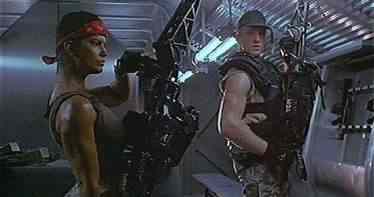
For the uninitiated, Aliens  is the 1986 follow-up to Ridley Scott’s uninventive but flawlessly executed Alien, and concerns the PTSD-afflicted Ellen Ripley’s ill-fated attempts to investigate (with the assistance of gum-chewing soldiers) the disappearance of an entire colony of humans on the planet where the titular phallus-bonced xenomorphs were originally found.


There are so many reasons to love this film from an aesthetic and technical point of view. Aside from the despicable haircuts, it’s hard to place it as a 1986 movie – a testament to the excellence of a production put together on (even then) a mediocre budget of eighteen million dollars. The academy award winning practical and special effects still equal those of any CGI-driven blockbuster of today, and even the slightly phony rear-projection face-offs with the Queen in her nest towards the end of the movie are more convincing than watching Ryan Reynold’s head floating against a background of pixellated green mush. The central character of Ripley is portrayed within a believable Feminist framework that is rare today. It is an action movie. It is a horror movie. It is a cyberpunk commentary on the dangers of unlimited corporate power. It’s even a serviceable Vietnam War allegory. To cover it all would require an entire book.

I remember seeing snippets of Aliens at a young age and finally saw the director’s cut in full aged fourteen when the boxset was released on VHS in 1997 before Alien Resurrection came out and ran head-first into a brick wall. What impressed me most was the design of the Colonial Marines’ military hardware – it was both futuristic and grounded within a recognisable practical reality. The designs are so cemented in the collective geek imagination that it they have been knowingly and smirkingly assimilated into other media. The UNSC troops and vehicles in the legendary Halo videogame franchise are the clearest example. Even Sergeant Apone makes an appearance in them under the guise of Sergeant Johnson.

One thing that is brilliant about the use of military hardware from a narrative point of view is that it underlines the menace of the xenomorph threat itself. The Colonial Marines are over-equipped to the point of complacence. Their weaponry is in fact overpowered to the point of liability – it indirectly results in the destruction of the colony they set out to save. One message of the movie is clear – flesh is stronger than steel. As an allegory for the trials of the US during the Vietnam War, it serves to illustrate how the superior numbers, guerrilla stealth and almost fearless nature of the North Vietnamese were more important than all the high-explosives at the Americans’ disposal.


Characterisation is a strength of this film – oddly because it doesn’t try too hard. The heavily-armed ready-meals who populate this film are painted with broad but memorable strokes. Sometimes, the best icons are the simplest. What really matters is the character of Ripley herself and how she is used to deftly handle second-wave Feminist issues in the script by Cameron (and some extent Alien screenwriters Giler and Hill).

Summary of powerful female characters in a modern film: take the recent Salt or maybe Tomb Raider (Jolie coincidence? I think not) or even the horrendously overrated marathon pop-video wank-fests known as Kill-Bill parts 1 & 2. Their approach is ‘because I am sexy, I am powerful’. Supermodel physiques that in reality can barely pull back the bed-sheets in the morning pull off feats of superhuman strength and speed far outclassing the obviously physically-fit male counterparts of these movies. I see this and I’m immediately bored. Why is it that their power has to be linked to their attractiveness in the most conventional terms? Why do we need to define female characters by their sexuality at all?

Aliens eschews all this and gives us in Ripley a character with powerful biological drive in terms of mothering instincts,  and assets that are universally praise-worthy in anyone. She is pragmatic, determined and cool-headed. She isn’t given any super-strength or inexplicable martial arts skills and the justification of her place in a masculine hierarchy certainly isn’t centred on her appearance. Surrounded by gung-go troops, an incompetent combat-virginal Lieutenant and a slimy corporate executive, she uses her experience and ingenuity to help the group survive. Some people might criticise Ripley, in her leather jacket and blue overalls, as being a character that’s essentially neutered. They might also argue that the loss of her own child and subsequent near-suicidal attachment to the orphan Rebecca (also known as Newt) are simply concessions made to give her a traditional female grounding. 


What is important here is that is we are dealing with the female not the feminine. Her biological leanings are inescapable and provide drive without defining her means of success. Other characters in the films mentioned above are defined in terms of the feminine – the artificial, socially contrived characteristics associated with females but which (though we get confused in our culture) have nothing to do with the essence of being female or even human. In short, the abilities that Ripley displays can be believed. There is a clear relation between her outward presentation and behaviour and what she achieves. She’s not even the ever-pouting super-bitch that is commonly portrayed as being the kind of woman who excels in a ‘male’ environment. Ripley is tough, but sensitive in quite a straightforward, undecorated manner. In other words, a great leader.

Unsurprisingly, another area in which Aliens excels is in its action ... or should we be surprised? If you added together all the action sequences from the 137-minute director’s cut, you probably only get about 35 minutes of action. In these scenes, the xenomorphs themselves are seldom in the same frame as the Colonial Marines and there are long moments of fighting where the aliens aren’t shown at all. Far from being simple cost-cutting exercises, these are strategies that make the action work. Marines blast away at middle-distance off-camera threats because they are in a confused situation and attacked by almost invisible enemies from all sides. Constant cuts to their out-of-depth Lieutenant watching their decimation from camera feeds enhance the sense of helplessness. Snap-cuts to creatures being mown down by sentry guns in a dark corridor give the impression of the beasts being innumerable even though we are only shown a few being involved at any time.

The sense of action, in short, relies on atmosphere for its thrill and menace. This is not a ‘literal’ action film that shows you everything in candid, realistic detail. The lighting in particular plays a crucial role. In one set-piece, the aliens make their way around the Marines’ barricade and into the Operations Centre by crawling under the floor and over the ceiling grates – but not before cutting the power. Cutting the power of course results in the engagement of emergency lighting which saturates the scene with murky blood-red tones that underline the primal horror of the moment, create a tantalising half-light which makes the creatures more threatening and serves as pathetic fallacy for the turning point wherein there is no hope for survival. During Ripley’s rescue of Newt and her final duel with the Queen, strobing hazard-lights create a tense visual heart-beat.


Aliens is fantastic not only as a stand-alone film but as a sequel. It isn’t the simple ‘more expensive version of the original’ approach taken by many films (though it did cost more). It operates on an entirely different dynamic and unravels some of the more mysterious elements of the original in a logical way. The nature of the xenomorph is expanded upon with the exposition of a hive hierarchy, and their survival strategies adapt when the conditions of their human enemies change. Expectations set up by the original – such as that all androids are untrustworthy tools of the evil Weyland Yutani Corporation – are toyed with and then smashed.

In summation, Aliens is a movie that has aged well. It has clever direction, sympathetic and believable spins on classic stereotypes, and stunning production design. It is a movie-geek’s dream as well as a satisfying mainstream action-horror. The more you know about this film, the more you appreciate it, mainly because so much was achieved with such limited resources. Despite having relatively little action, what there is happens to be well-paced and hits harder because of the dramatic tension that develops between.

... and plus, Bill Paxton makes this face:


What more could you want?


ABOUT THE AUTHOR

 DAVID M. JACKSON is the semi-fictitious construct of a crazed Language and Literature lecturer born in Essex and working in Berkshire.

He has loved Science-Fiction all his life and regards it as the ultimate means of developing complex hypotheses regarding how technological development catalyses social change.
He is pretentious and precocious enough to have been writing Science-Fiction since the age of fourteen, though most of those ideas are in quarantine. When cleansed of their impurities, he will rebuild them faster, stronger and better than before.

His corporeal avatar currently occupies a position in real-space approximately 1.6 meters in height, 0.6 meters in width, 0.35 meters at its deepest point and 98 kilograms in weight according to the metric increments employed by homo-sapiens in the industrialised territories of Earth (Solar System).

If you want to read more from David M. Jackson, look for his new novel Fidelity, Bravery, Integrity on Amazon – due out as an eBook from 1st July 2012.

Set in the near future, Fidelity, Bravery, Integrity sees cybernetically augmented police officer Jennifer Carter fighting to avenge her father’s death, evade arrest by her former colleagues and hold on to the last remnants of her humanity as Britain explodes into civil war.
Our real enemies are closer to home than you think …