Showing posts with label the road. Show all posts

Thursday, 22 March 2012

Dystopian Visions: The Future is Bleak

I love a disturbing vision of the future.  In honour of The Hunger Games and it's tributes, districts, peacekeepers and televised battles to the death, here's my top 10 depressing movie dystopias.

But before I start, there are some films that are possibly disputed dystopian visions that need a mention here.  The documentary Collapse features Michael Ruppert dishing out his version of what he sees as the future of the human race and it is disturbing and terrifying and I have not been able to forget it.

The Truman Show, A Clockwork Orange, Nineteen Eighty Four, The Running Man, Battle Royale and Series 7: The Contenders must also get a mention here.  Some of these are clearly big influences on The Hunger Games.

But on to the main event.  Here's my top 10:

10. The Road (John Hillcoat, 2009)

Viggo Mortensen and son trudge the road to nowhere in a grey, depressing future full of cannibal survivors of environmental devastation.  Relentlessly grim and mournful, it's a bleak, miserable, whimpering end to the human race.  And even the planet itself is dying in this post-apocalyptic misery-fest!


9. District 9 (Neill Blomkamp, 2009)

Not sure if this is actually an alternative present but it feels like a not too distant future as aliens have got themselves shipwrecked in the townships of South Africa and humans go about treating them in much the same way we've been treating each other for the last god knows how many years.


8. 12 Monkeys (Terry Gilliam, 1996)

Disease has wiped out 99% of the population of the planet and the remainder live underground and send convict Bruce Willis back in time to find out what caused the epidemic.  Trippy, twisty, terribly clever tale of time travel that may not spend much time in it's terrible future but still has a big enough impact to make this list.


7. Planet of the Apes (Franklin J.Schaffner, 1968)

SPOILER!  One of the best twists of all time.  The planet of the apes is Earth!  We've been overrun by talking apes and now we are slaves on our own planet.  Of course this only becomes clear in the final moments of the film, but what a knockout ending and brilliant vision of the future.


6. Wall-E (Andrew Stanton, 2008)

Earth has become a (strangely beautiful) bin planet.  The corporations have taken the fat, lazy human race into spaceships and left the Earth to little rubbish robots like our hero Wall-E.  I'm not sure what's more frightening; the endless mountains of trash that cover the Earth or the depressing vision of what the human race becomes when they no longer have to get out of their seats anymore.


5. Waterworld (Kevin Reynolds, 1995)
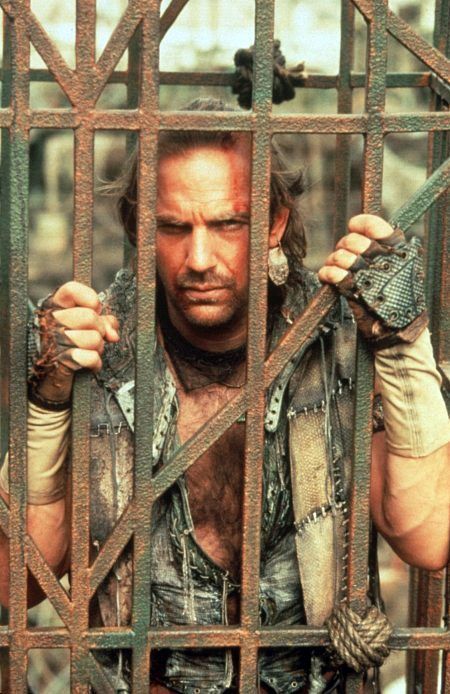
Mad Max on water.  Beginning with the flooding of the Earth by the melting of the polar caps, Waterworld takes us into a future where the human race live on floating atolls, terrorised by The Smokers with their oil tanker and jet ski's and mad leader Dennis Hopper.  The sight of cities below the sea as revealed by the mutated hero (Kevin Costner with gills!) and the quest to find mythical dy land make this an exciting but worrying vision of the future.


4. Demolition Man (Marco Brambilla, 1993) 

You can't swear, you can't eat red meat, you can't have sex and you have to use three seashells to wipe your ass.  This is about the most joyless dystopia there is.  Ok so everyone seems fine, there's no murder etc etc but this is a vision of a nanny state gone mad.  So fortunately a killer from the past escapes which then requires a cop from the past to take him down.  Denis Leary leads the underground revolutionaries and Stallone swears and fights his way to a showdown with Wesley Snipes' loony.

3. The Matrix (The Wachowski Brothers, 1999)

Humans have been imprisoned by machines.  We're used as batteries and plugged into a grid that allows us to think we're living in the real world but actually it's a simulation created by the machines.  The real world however is even worse.  Those who have escaped the Matrix have to live in Zion, an underground hell of terrible raves and the constant threat of destuction from giant mechanical squids.  Ignorance is bliss.  Plug me back in.

2. The Terminator (James Cameron, 1984)

Only briefly glimpsed until Terminator: Salvation, this franchise created a similar vision to The Matrix.  Technology has become our downfall with machines taking over and waging war on the human race.  The resistance is led by John Connor but only if he can survive time travelling attacks on his mother in the 80s and then his teenage self in the 90s.  Fortunately for every terminator the machines send back in time, the John Connor of the future has a saviour of his own to send back to save his former self.

1.  Children of Men (Alfonso Cuaron, 2006)

The best dystopias are recognisable from the present.  And they don't come any more recognisable than this.  In the not too distant future, the human race has become sterile.  Displaced immigrants are locked up and treated worse than animals in refugee camps by the sea.  Bombings are regular occurences as terrorist organisations spring up.  The human race is hopeless, obsessed with the youngest man on the planet who is killed in the first scenes of the film.  Patriotism is encouraged by the powers that be, but the people are downtrodden, miserable and ready to give up.  Only when Clive Owen hooks up with a miraculously pregnant young woman is there any sign of hope in this bleak vision of future England.

Now it's your turn!  What are your favourite movie dystopias?  Did anyone else like Michael Bay's The Island?  Would The Hunger Games make your list?

Saturday, 11 June 2011

Review of 'The Road' (John Hillcoat, 2009)

Synopsis: Father and son travel a long, long road, battling the elements, cannibals, starvation and the temptation for suicide in post-apocalyptic America.

According to Hollywood the world’s going to end very soon. Not sure how, not sure why… all that’s clear is that civilization will crumble and only a few survivors will be left. As if the idea of the decimation of most of the world’s population isn’t depressing enough, John Hillcoat’s The Road plunges the viewer into the desperate, hopeless struggle of a father and son to survive against misery, despair and the degenerate remnants of humanity. For much of its run time, the film is unrelentingly bleak, pessimistic and difficult to enjoy. Sadness and hopelessness bleeds from every frame. Still, for fans of drama, this film is a real tearjerker. Stick with its slow pace for a rewarding ending that may surprise with its glimmer of hope after all the preceding misery.
T he Road is unlikely to appeal to fans of other recent post-apocalyptic cinema such as I am Legend, The Book of Eli and Terminator Salvation, but if viewers are willing to succumb to its mounting sense of despair and forget about action set-pieces, there is plenty here to, perhaps enjoy is not the right word… but… appreciate.

The plot is barren like the landscape the protagonists are travelling. Like Lord of the Rings, there is a great deal of walking to be done (only this time Aragorn does a hell of a lot less fighting along the way). This is road trip without the girls, drugs, good times with great friends or even a sodding car. So much of the film is just the man and his son (Viggo Mortensen and Kodi Smit-McPhee) walking, occasionally talking and grimacing at the cold, the hunger and the fear of strangers on the titular road. The two leads carry the film, helped only briefly by interludes of flashbacks/dreams that add to the overwhelming sense of despair coursing through the veins of the film. In these flashbacks Charlize Theron has a thankless but memorable role as suicidal wife and mother that adds to the hopelessness of it all. The flashback structure adds to the poignancy of the central relationship between the father and son and reminds the viewer of the determination of the pair to survive. Cameos from Robert Duvall, Guy Pearce and other assorted travelling folk (some friends, some foes) add interest to what could become a stale, repetitive and unbearably slow and depressing slog.

Duvall is fantastic in a brief role, but Mortensen and Smit-McPhee shoulder the burden of the entire film. Rarely off screen, Mortensen’s performance is haunting; gaunt, caring, determined and half-broken. It is an incredible performance. Smit-McPhee is equally good with a whinier role but some heart-wrenching scenes that he pulls off convincingly. With scenes that require the father to put a gun to the head of his son in moments of desperation and despair, the pair are outstanding and believable throughout.

While the pace is slow, the film feels a hell of a lot faster than the book which is a difficult read, despite its prize-winning popularity. The cinematography is excellent, particularly with the strangely beautiful shots of decimated landscapes. The never ending grey adds to the relentlessly bleak tone. Grey skies, grey trees, grey buildings and grey sea. Life has left this planet and it shows in every frame. Moments of colour are only glimpsed in reminders of what the world used to be; the opening flashback, the solitary coke can. Nick Cave and Warren Ellis’ score complements the tone and gets under your skin with its sad, unrelenting piano.

This film is far from the crowd pleasing post-apocalyptic scenarios of films like I am Legend. Cannibalism, starvation, rape and suicide are all very real threats to the protagonists. The film seems to be dealing with notions of morality with the father constantly teaching his son right from wrong. The boy must learn to be a good guy, not a bad guy. But the film questions the father and his moral codes, as the son does. What is bad in this new world? Is stealing wrong? Is suicide wrong? Is cannibalism wrong?

It could also be argued the film also implicitly deals with contemporary America. The idea of fear and isolation and shutting oneself off from the ‘bad guys’ is crushingly foregrounded in the closing moments of the film. The idea that so many of these apocalyptic films have been made recently is because of American fears of civilizations imminent collapse rings true. The use of the gun as the last hope a man can have of protecting his family feels very right-wing and familiar from so many other American films. But the gun is almost used on many occasions in the film to prematurely end life, not just as protector of the family. The cause of the apocalypse is never explicitly stated but the original book has been praised by environmentalists for taking the potential outcomes of the human races current actions as a serious threat.

The Road is undoubtedly a tough watch. It’s not a popcorn/multiplex kind of movie and fans of 2012 and I am Legend may possibly want to give this a miss. It is a slow, grey and depressing film. There is very little action but many moments of suspense; heartbreaking, unbearably tense in places and carried by a pair of grim but inspiring protagonists, played with conviction by a couple of bright stars.