Can somebody make sure that Suicide Squad gets rated 18 please?
I haven't got anything against kids, but I'd just like to make sure the bad guys are reeeeally bad in this. No redemption. No corny Will Smith jokes. More Jared Leto hurting people really badly please.
He's got a tough job ahead, trying to get us all to forget about Heath Ledger as the Joker. If anyone can do it, I have faith that Leto might be our guy.
This trailer shows that Batman gets mixed up in the affairs of the Suicide Squad, which is a good sign, both for DC's world building and for the action stakes.
Most of all, I worry that Will Smith might be the key to wrecking this. The character looks cool, but I want to see less world saving, and more villains doing what they do best.
Has anyone who has read the comics got any inside information for me on this? Do all the bad guys turn good? I bloody hope not.

Showing posts with label will smith. Show all posts
Showing posts with label will smith. Show all posts
Monday, 13 July 2015


Wednesday, 25 February 2015
Focus Review
Will Smith needs a hit. Since
taking a break from acting between 2008 and 2012, Smith has returned to rest on
his laurels in MIB3, and to appear in a pair of undisputed duds (After Earth
and Winter’s Tale). It’s now been seven years since he was legend, 12 years
since he was last a bad boy and almost 20 years since he saved the world from
planet toasting aliens in Independence Day.
While Focus sees Smith as a bit
of a bad boy, it’s a far cry from his heyday as the king of the blockbuster
opening weekends. In Focus, Smith plays Nicky, a con-artist extraordinaire, who
learned the ropes from his notorious father and now works with a tight crew to
rip off (mostly) extremely rich people. When Margot Robbie’s Jess enters his
life in a misguided attempt to con the king of the game, she asks to be taken
under his wing in order to learn from the best. Hitting up the Superbowl in New
Orleans, Jess and Nicky start to develop a romantic relationship, but then
suddenly things go awry. The remainder of the film takes place three years
later as Jess and Nicky are thrown together again as Nicky is involved in an
operation to grab millions of Euros from a Buenos Aires Formula One game. Can
the pair overcome their past to make it out with the millions?

Focus is yet another film full
of cons, double crosses, dodgy dealings and twists. Will Smith and Margot
Robbie are such an astonishingly attractive couple that it is hard to focus on
their light fingered movements and the way the films writers/directors are
manipulating and using misdirection to pull the wool over our eyes. It’s easy
to just enjoy the surface shine of the film with New York, New Orleans and
Buenos Aires all looking stunning as this ridiculously good looking pair breeze
their way through the story.
It’s amazing to see how the
other half live. Focus has rich revellers taking to the streets of New Orleans
and having their valuables pilfered. It has gamblers in special seats high
above the Superbowl game making million dollar bets and it has Formula One team
owners living lives of luxury in the beautiful Buenos Aires. It also has some
clever twists and turns, where the con is not quite as expected and the
storytellers stay one step ahead of the audience.
However, it also has some
ludicrous last minute revelations that don’t really add up when looked at too
deeply. However, with Will Smith on smirking form, Margot Robbie looking
sensational in a range of stunning outfits and a look into the how the
wealthiest on this planet live, it’s hard to focus on the story, instead of
just how damn fine everything looks in this movie.
Interestingly, sleight of
hand expert Apollo Robbins was a consultant on the film. If you haven’t seen
his TED talk about misdirection and controlling attention, go watch that to see
how easily a real con artist can snatch your valuables. Focus doesn’t steal
your money and offer nothing in return, but some of its sillier twists and
turns may ultimately leave you feeling a little short-changed.
Watch the trailer:
Recent reviews from I Love That Film:
Cake
Predestination
Love is Strange
Coherence
Jupiter Ascending
Selma
Kingsman: The Secret Service
Son of a Gun
Sunday, 16 June 2013
Media Literacy and Intertextuality: The Relationship between Audiences and Films Part 4
Another major factor or framework of interpretation that must be considered is the media literacy of the viewer. If someone is very educated about the media, as in they have done a media course or they watch a lot of special features on DVD’s and are very aware of how media texts are constructed, then this is likely to have an impact on their enjoyment and interpretation of a film. A viewer who is more media literate will likely be aware of how the text is positioning them and may therefore be less suggestible to the messages of the film. This viewer will be more aware of how the preferred readings of a film are constructed and may therefore resist the ideology or messages of the film more than someone who is less aware of how films construct meanings and provoke specific emotional responses.

For example some viewers may find
Kidulthood to be a realistic depiction of London’s
youth whereas others may see it as a sensationalistic film that stereotypes London teens in order to
sell more tickets at the box office. Some viewers will not enjoy fantasy films as much because
they are overly aware of how the special effects are created and this ruins the
magic for them. Some viewers may appreciate the films of Tarantino more or less
than others because they are more or less aware of the references to other
films that Tarantino alludes to. They may also enjoy a film such as Pulp Fiction more because they find the structure challenging and interesting
compared to a traditional narrative whereas others may find the non-linear narrative confusing and pointless.

This also ties in with intertextuality
which is where a film references another piece of media. This can be deliberate
or unavoidable. For example spoofs such as Scary Movie deliberately reference
other films such as Scream in order to parody them and make viewers who are
aware of the film being referenced, laugh at the imitation. People who have
seen Scream are more likely to enjoy Scary Movie as they will be more familiar
with the target of the mockery. Tarantino on the other hand pays homage to
films he loves such as Lady Snowblood in Kill Bill or City on Fire in Reservoir
Dogs by imitating them but not to mock them and make people laugh.

However intertextuality can also be less
deliberate and almost unavoidable. This is often the case with genre films and
the use of stars. Any time a filmmaker wants to make a slasher film where a
killer stalks a bunch of kids and stabs them one by one, that film will always
have unavoidable references to the whole slasher sub-genre of horror. Similarly,
any time a filmmaker casts a star such as Will Smith for example, the viewer is
likely to be reminded of previous Will Smith films. If I see Will Smith on a
poster, I suspect he may save the world (or at least be the hero) because I’ve
seen him do this a few times. I see Jim Carrey and I expect a comedy. This can
be used to sell a film or it can be used to subvert expectations but either
way, the use of certain generic conventions or stars can impact the experience
for the viewer, particularly if they are media literate or very knowledgeable
about films.
Did you miss...?
Part 1 on active vs passive spectatorship.
Part 2 on the pleasures of film watching.
Part 3 on frameworks of interpretation.
Read more:
Part 5 on the effects of films.
Part 6 on fandom and film fans.
Part 7 on pre and post-viewing experiences and conditions of reception.
Saturday, 6 October 2012
When Singers Become Actors
 The late Whitney Houston returns to the big screen today in Sparkle -
the film that would become her last acting role. The musical drama sees
Houston play the part of Emma, mother to three young ladies seeking
fame as a girl group, while she warns them of the perils of the life
they so desperately crave.
The late Whitney Houston returns to the big screen today in Sparkle -
the film that would become her last acting role. The musical drama sees
Houston play the part of Emma, mother to three young ladies seeking
fame as a girl group, while she warns them of the perils of the life
they so desperately crave.Singers turning to acting is not a new phenomenon – singers from Barbra Streisand to Eminem have been turning their talents to the big screen for decades and though not all have done it well, some have shone in their attempts.
Head over to Filmoria to find out who the team have chosen as their standout performances by singers who have truly become actors.
Featuring Will Smith, Plan B, Frank Sinatra and more.

Friday, 13 April 2012
Movie Icons: A Very Interactive Post
What is an icon? I start this post with a question because I wish to begin as I intend to continue.
'A person or thing regarded as a representative symbol of something: e.g. "an icon of manhood".'
That's one of the only answers you'll get today. Wikipedia says 'Some writers say that the terms "icon" and "iconic" have been overused. A writer in Liverpool Daily Post calls "iconic" "a word that makes my flesh creep", a word "pressed into service to describe almost anything."'
I can understand their point. Somewhere in the back of my mind I remember knowing that an icon is a representative symbol of something. But when I use the word iconic, I think I'm actually thinking more along the lines of 'unforgettable'. I think somebody once told me that icons could always be recognised by their silhouette. So in Hitchcock's final film, Family Plot, we recognise his cameo appearance just from his silhouette for example.

But then I type 'movie icons' into Google images and I get this:


I am aware I'm rambling but I wish to get to the bottom of this. Can I say that any film character is an icon if I feel s/he is a representative symbol of something to me personally? Do I have to justify my use of the word iconic to anybody? I recently heard a blogger ranting about the over use of the word masterpiece. Do we really need to hold back on using words like iconic and masterpiece and save them for only the specialist occasions. I'm sure most people do but doesn't it all come down to opinion?
What about stars? I can clearly see how characters can be iconic. Many characters are written to be symbols. But stars? How can they be iconic? I mean really iconic?
MSN thinks they can be:

In the 00's we have: Will Smith, Nicole Kidman, Natalie Portman, Will Ferrell, Sean Penn, Johnny Depp, Keira Knightley, Clooney, Winslet and Jolie.

In the 90's we have: Pitt, Hanks, Willis, Thurman, Julia Roberts, Susan Sarandon, Jim Carrey, Winona Ryder, Meg Ryan

In the 80's we have: Eddie Murphy, Bill Murray, Schwarzenegger, Meryl Streep, Tom Cruise, Harrison Ford, Molly Ringwald, Kathleen Turner

The list goes on and on, check here for the 70s, the 60s, the 50s, and apparently MSN then decides there were no icons before this last decade. So no Chaplin, Buster Keaton, Laurel and Hardy etc.
I'm just not sure if all of these stars are really iconic. I mean what is Brad Pitt a representative symbol of? Now Tyler Durden maybe... but not Brad Pitt himself surely? And what about Johnny Depp? Edward Scissorhands I can see being iconic, Captain Jack even maybe at a stretch... but not just Johnny Depp.


So another question for you and I hope you are making a note of all these because I NEED answers! What makes a star iconic?
Finally, I'm more interested in iconic images than I am with iconic stars or even iconic characters. So what do you think are the most iconic images of cinema? For me it just doesn't come any more iconic than this. I could talk about this image all day but I'll leave that for another post.

Over to you! Please give me some answers to my endless questions and I will be forever in your debt!
More popular posts at I Love That Film:
TV in 2013: Breaking Bad, Dexter, The Walking Dead, Homeland and more
Analysing La Haine
5 MUST SEE films at the BFI London Film Festival 2014
Valentines Day; Time for Romance
The Femme Castratrice in Horror
Why I Love The Hunger Games
'A person or thing regarded as a representative symbol of something: e.g. "an icon of manhood".'
That's one of the only answers you'll get today. Wikipedia says 'Some writers say that the terms "icon" and "iconic" have been overused. A writer in Liverpool Daily Post calls "iconic" "a word that makes my flesh creep", a word "pressed into service to describe almost anything."'
I can understand their point. Somewhere in the back of my mind I remember knowing that an icon is a representative symbol of something. But when I use the word iconic, I think I'm actually thinking more along the lines of 'unforgettable'. I think somebody once told me that icons could always be recognised by their silhouette. So in Hitchcock's final film, Family Plot, we recognise his cameo appearance just from his silhouette for example.

But then I type 'movie icons' into Google images and I get this:
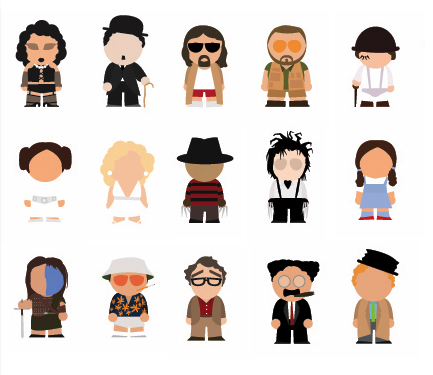
I guess these little pictures are just icons because they are representative of the actual characters that they stand for. Is that right? And could somebody enlighten me as to who the last one is please? I was expecting actual pictures of Monroe, Bogart, Chaplin but not these little ladies and gentleman.
In fact I scroll down and the first actual pictures of people I get are quite a way down:


Which gets me thinking? Is there room for debate about who our movie icons are? Or do some higher powers have to bestow the term 'icon' before us common muck can use it? Why are the above characters iconic? How long does it take to become iconic? Is it instant? Was Ledger and Nolan's Joker instantly iconic? Was the Joker already iconic before The Dark Knight and therefore any fresh incarnation of the villain will always be iconic?
What is Frankenstein a representative symbol of? The undead? The arrogance of man messing with the powers of God?
What about stars? I can clearly see how characters can be iconic. Many characters are written to be symbols. But stars? How can they be iconic? I mean really iconic?
MSN thinks they can be:

In the 00's we have: Will Smith, Nicole Kidman, Natalie Portman, Will Ferrell, Sean Penn, Johnny Depp, Keira Knightley, Clooney, Winslet and Jolie.

In the 90's we have: Pitt, Hanks, Willis, Thurman, Julia Roberts, Susan Sarandon, Jim Carrey, Winona Ryder, Meg Ryan
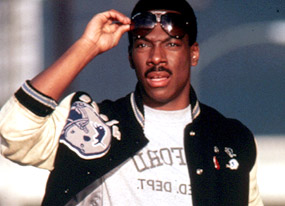
In the 80's we have: Eddie Murphy, Bill Murray, Schwarzenegger, Meryl Streep, Tom Cruise, Harrison Ford, Molly Ringwald, Kathleen Turner

The list goes on and on, check here for the 70s, the 60s, the 50s, and apparently MSN then decides there were no icons before this last decade. So no Chaplin, Buster Keaton, Laurel and Hardy etc.
I'm just not sure if all of these stars are really iconic. I mean what is Brad Pitt a representative symbol of? Now Tyler Durden maybe... but not Brad Pitt himself surely? And what about Johnny Depp? Edward Scissorhands I can see being iconic, Captain Jack even maybe at a stretch... but not just Johnny Depp.


So another question for you and I hope you are making a note of all these because I NEED answers! What makes a star iconic?
Finally, I'm more interested in iconic images than I am with iconic stars or even iconic characters. So what do you think are the most iconic images of cinema? For me it just doesn't come any more iconic than this. I could talk about this image all day but I'll leave that for another post.

Over to you! Please give me some answers to my endless questions and I will be forever in your debt!
More popular posts at I Love That Film:
TV in 2013: Breaking Bad, Dexter, The Walking Dead, Homeland and more
Analysing La Haine
5 MUST SEE films at the BFI London Film Festival 2014
Valentines Day; Time for Romance
The Femme Castratrice in Horror
Why I Love The Hunger Games
Subscribe to:
Posts (Atom)