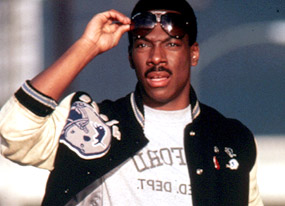
Found this essay from my university days and thought it might be of interest to anyone studying racial representation in film:
The 1980s were a
conservative time in both America
and Britain. Reagan and Thatcher were the leaders of
countries that had begun a harsh backlash on the relatively free and
progressive 60s and 70s. Guerrero (1993)
argues that films of this period were dominated by an ideologically
conservative cycle of production. The
many interracial buddy pictures of the 80s and many of those of far more recent
years are a part of this conservative cycle. Many critics argue that black sexuality is being
controlled in these films, in some cases subtly and in others such as 48 Hours
(Walter Hill, 1983), literally and overtly.
As Bogle (2001) argues, interracial partners can only be ‘buddies’ when
the white one is in charge. White fear
of black sexuality has been clear from the moment the two cultures collided;
after all, sexuality was what one expected of savages and they were described
as beastly, a term that had strong sexual connotations, in those days (Jordan,
2000). This essay will attempt to show
how black sexuality is controlled in American films, how it is not controlled
by some filmmakers, and also if it can be argued that more than just black
sexuality is being controlled in dominant cinema.

After the fall of
blaxploitation films, Hollywood
began containing the black presence on the screen in the 80s. Black sexuality is very often controlled in
the interracial buddy pictures of the decade.
The Black lead, for example Eddie Murphy in 48 Hours, is put ‘in the
protective custody… of a white lead… and therefore in conformity with dominant,
white sensibilities and expectations of what blacks should be like’ (Guerrero,
1993). This is shown very clearly in 48
Hours with the first of image of Eddie Murphy singing happily to soul music as
he sits in a prison cell, oblivious to his surroundings. Eddie Murphy’s character, Reggie, is
literally controlled throughout the film by the white cop played by Nick
Nolte. He constantly puts down the black
character and treats him like scum that cannot be trusted for the majority of
the film.
Jacquie Jones
(1993) argues ‘the black male character in mainstream film… is always the
oversexed caddish character of Eddie Murphy in 48 Hours… his sexual behaviour
functions as an indictment of his feral nature’. In 48 Hours we see Reggie chatting up prostitutes in the
police station before being lead away by and clearly dominated and controlled
by the American lawman played by Nolte.
This portrayal of black sexuality as being insatiable and therefore
needing to be controlled is present in many other films of the period such as
‘The Colour Purple’ (Steven Spielberg, 1985) and ‘Mona Lisa’ (Neil Jordan,
1986) and has been present in dominant cinema since ‘The Birth of a Nation’(D.W.
Griffiths, 1915). Guerrero (1993) argues
‘black sexuality in the 1980s was either constructed as something entirely
perverse or… absent in mainstream cinema’.
Hence Murphy has no love interest in 48 Hours, Trading Places (John
Landis, 1983) or the Beverly Hills Cop films.
In Trading Places, as with 48 Hours ‘the white hero… is granted a
leading lady… while the film has no intention of setting up a relationship for
Murphy’ (Bogle, 2001).

Another method
that American lawmen, this time real
lawmen, use to control black sexuality on the screen is through
censorship. It has been argued that
‘(Spike) Lee, like other African Americans who have tried to humanise the
representation of black sexuality, had problems getting his film past dominant
cinema’s censorship apparatus’ (Guerrero, 1993).
Black sexuality is
also controlled by far more than just American lawmen though. It is controlled by the scriptwriters and
white Hollywood’s
fear of black sexuality. Guerrero (1993)
argues that there is a ‘consistent reluctance to deal honestly with Black
romance or sexuality, especially when it is interracial’. The bar scene in 48 Hours demonstrates
perfectly the way in which Black men are positioned in Hollywood
film. As well as suggesting a strong
fear of blacks having power (‘I’m your worst nightmare… a nigger with a
badge’), the scene shifts the object of the gaze from a half naked dancing
white woman to Eddie Murphy making a spectacle of himself. At no point is Murphy considered as a partner
for a white woman, instead they are both positioned for the gaze of the white
male spectator.
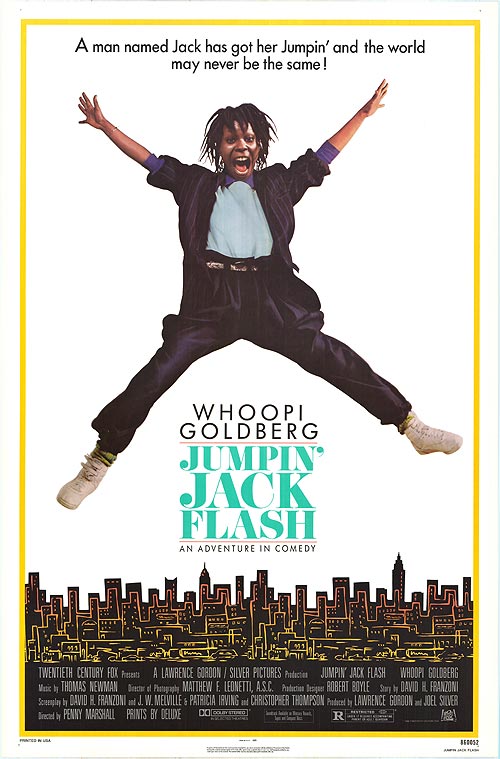
Also Bogle argues
that Whoopi Goldberg is never allowed sexuality in her films and in particular in
‘Jumpin’ Jack Flash’ (Penny Marshall, 1986), there is no romance between Whoopi
and the white man she saves, ‘in such films… so unattractively and absurdly
dressed was she in oversized clothes or sneakers that she seemed defeminised’
(Bogle, 2001). However this is Bogle’s
opinion of what is unattractive and unfeminine and there is a counter-argument
that would emphasise how progressive it is that women do not have to appear
sexy in films to take the lead roles.
On the other hand
there are films that have explored and shown black sexuality, mostly made by
black independent filmmakers such as Spike Lee and Charles Burnett. In She’s Gotta Have It (Spike Lee, 1986), the
main character of the film is a black woman and the narrative is all about her
relationships with men. The film however
touches on the idea of insatiability of black sexuality as the woman has three
male lovers. Nevertheless films like
Killer of Sheep (Charles Burnett, 1977) ‘allow for the normalisation of the
black character by valuing sexuality’ (Jones, 1993). Similarly Guerrero (1993) argues that such a
film ‘reconstructs the world on screen from black points of view cast in
liberating images’.
An example of how
black sexuality may not be controlled in Hollywood
cinema would seem to be Lethal Weapon (Richard Donner, 1987). Guerrero (1993) argues the film ‘contrasts
the wise restraint of an older black cop… with the risk-taking, violent actions
of his younger white partner’. In this
case the black character is the family man, the ‘buddy’ that is allowed a life
and sexuality of his own that is even explored in the narrative. Lethal Weapon also touches on the idea of
black sexual insatiability again, with the black cop’s daughter developing a
crush on the white ‘buddy’ played by Mel Gibson. However Bogle sees something far more
sinister happening in the film, arguing it ‘makes the black family acceptable
for the mass white audience by carefully scrubbing it “clean” of too strong an
ethnic identity’ (Bogle, 2001). He then
calls the 80s the ‘era of tan’, a time when Hollywood wanted people to forget the
blackness of black stars. Hence the
family in Lethal Weapon is described as ‘a dab of black here, a dab of white
there… a perfect composite tan’ (Bogle, 2001).

This draws
attention to the most common and worrying argument hinted at by many black
critics. It is in fact not black
sexuality that is being policed in dominant cinema, but the black image and
black culture that is restricted and controlled. The conservative times that were the 80s lead
to blacks being marginalised in all areas of the film industry,
as Guerrero (1993) states, blacks ‘found themselves confronted with the
“recuperation” of many of the subordinations and inequalities they had
struggled so hard to eradicate’. Bogle
argues the backlash against counterculture and blaxploitation meant the
subconscious goal of 80s films was to make ‘audiences believe such (rebellious)
figures no longer existed or… they could really be tamed, disposed of, or
absorbed into the system’. This is
clearly illustrated in 48 Hours when Murphy’s character Reggie chooses to go
back into prison.
It also seems
there is a major contradiction in what some critics have written about the
‘buddy’ comedies. Guerrero (1993) states
that ‘Hollywood has deployed a variety of narrative and visual “strategies of
containment” that subordinate the black image and subtly reaffirm dominant
society’s traditional racial order’. His
first example of this is when a black star is given top billing in a film but
is then isolated from any reference to the black world, as in numerous buddy
films. However he also states that ‘the
buddy formula is able to attract the demographically broadest possible
audience’. Therefore the fact that black
culture and sexuality is suppressed in these films is due to more than just the
underlying racism in much of dominant cinema.
Hollywood’s
sole goal is money, therefore having a black star and a white star sharing
screen time is the most obvious way to pull in white and black audiences, and therefore maximise
potential profits.
The interracial
buddy films can be seen as a fusion of blaxploitation action adventure films
such as Shaft (Gordon Parks, 1971) and the all white male buddy pictures such
as Midnight Cowboy (John Schlesinger, 1969) except with the black leads being
relegated to sidekick or comic relief status.
Black sexuality is controlled in these films, but this is part of a much
bigger effort to control and suppress black culture in Hollywood
films. This is proven by the 90s ‘hood
movies which mainly represent African American culture as revolving around guns
and drugs, bitches and hoes. This also
emphasises the point that black culture must be ‘sellable’ to white audiences
and hence the packaging of black culture in many films with a singular black
star.
BIBLIOGRAPHY
Guerrero, E.
(1993) Framing Blackness: The African American Image in Film,
USA: Temple University
Press
Guerrero, E.
(1993) The Black Image in Protective Custody: Hollywood’s Biracial Buddy Films of the
Eighties In: Diawara, M. (ed.) Black American Cinema. London. Routledge
Jones, J. (1993)
The Construction of Black Sexuality In: Diawara, M. (ed.) Black American
Cinema. London.
Routledge
Bogle, D. (2001)
Toms, Coons, Mullatoes, Mammies and Bucks: An Interpretive History of Blacks in
American Films. USA:
Continuum
Jordan, W. (2000) First Impressions In: Back, L. and Solomos, J. (eds.)
Theories of Race and Racism. London:
Routledge
Yearwood, G.
(2000) Black Film as a Signifying Practice: USA, AWP
Miller, C. (1996)
The Representation of the Black Male in Film [online] Available from: http://www.pressroom.com/~afrimale/miller.htm
[Accessed 4th March 2004]