Showing posts with label stars. Show all posts

Sunday, 23 November 2014

The Rise and Rise of Jack O'Connell: From This is England to Unbroken


In case you hadn’t noticed, Jack O’Connell is about to go mega-star massive. His next film appearance will be in Angelina Jolie’s second film as director, Unbroken. This is the true story of Louis Zamperini, an Olympic athlete turned military man and plane crash survivor who then survived years of torture as a prisoner of war. Zamperini is an incredible man with an unbelievable life story and Jolie has plucked the relatively unknown (at least in the US) O’Connell to bring Zamperini to life in a film that is sure to gobble Oscar nominations in 2015.

Angelina Jolie Unbroken

Angelina Jolie


I’ve had my eye on Jack O’Connell for a while now, even if his career to date had been filled with an alarming amount of tough guy thugs. I can’t say I noticed him or paid any particular attention to him way back in one of my favourite films This is England but he is there and the performance is notable as O’Connell’s Pukey isn’t his usual brand of wideboy. O’Connell’s character has a particularly terrifying encounter with Stephen Graham’s menacing racist Combo when O’Connell dares to challenge his beliefs.

this is england jack o connell

O’Connell had many roles in British TV from The Bill through Waterloo Road, Wire in the Blood and Skins but it was the double whammy of Eden Lake and Harry Brown that cemented his status as a go-to-geezer for low-budget British filmmakers. In both these films, but particularly Eden Lake he got to play terrifyingly horrible little bastards; becoming incredibly memorable as the kind of hooded monster that the media was always banging on about as the use of the word ‘chav’ became acceptable in the tabloid press. Banging heads with Michael Fassbender and Michael Caine, Jack O’Connell managed to easily hold his own with these older and more experienced acting greats.

Eden Lake clip


O’Connell was then given bigger parts in the likes of little known films such as Tower Block and The Liability. They may be small films but O’Connell’s swaggering performances were bigger and better than the films he was in. Playing the hoodlum was a speciality and O’Connell could have easily been stuck by typecasting positioning him as a loudmouth loutish lad for life but then he was delivered a couple of really interesting roles to start flexing his acting muscles with.

Tower Block Trailer


The Liability Trailer


While a small but notable role in 300: Rise of an Empire allowed him to show off a six pack and likely take a tidy paycheque, it was his performances in the excellent Starred Up  and '71 that should really have seen him become a massive star in 2014. As young convict Eric Love in Starred Up , O’Connell got to face off with Ben Mendelsohn as his jailbird father but also show a fascinating vulnerability beneath the bravado. Similarly, in '71 his usual swagger was replaced by a limp as O’Connell’s soldier spends most of the film injured, scared and running for his life from the IRA in Belfast.

Starred Up Trailer


I’d recommend any of these films, particularly just to watch O’Connell at work. His rise to the top has been filled with great performances but Unbroken looks set to be the one that really puts him on the international map. 2014 has already been an exceptional year for the star but it will be crowned by the true life story of horror and hope that Jolie has in bringing to big screens on Boxing Day. Don’t be surprised if O’Connell is up for Best Actor in 2015 awards season. He’s already earned it.

Unbroken Trailer


Still here? What is your favourite performance from Jack O'Connell?


Trailers at I Love That Film

Reviews at I Love That Film

London Film Festival 2014

Buy my book on The Blair Witch Project

Videos from I Love That Film

Friday, 5 April 2013

Great Actor/Director Collaborations #1 David Fincher and Brad Pitt

Lying awake last night and thinking about all the things I'd like to blog about and worrying that I Love That Film has no running features, I kept thinking about all the great actor/director collaborations there have been in cinematic history. I say history, but actually I was thinking mostly about modern ones. So hopefully this is going to turn into a semi-regular feature.

My thoughts immediately turned to David Fincher and Brad Pitt who have made three films together: Seven, Fight Club and The Curious Case of Benjamin Button.


"They're like brothers - opposite in the way they act, but they understand each other the way families do." Taraji Henson (Bowles, 2008)


Brad Pitt gained international recognition as a sex symbol for his supporting role in Thelma and Louise in 1991. Pitt went on to secure his reputation as a handsome leading man with larger parts in A River Runs Through It and Legends of the Fall.  However his appetite for edgier roles was clear from his early work as a psychopath in Kalifornia, and his cameo in True Romance as a couch potato stoner.


On the other hand, David Fincher began his directing career in commercials and music videos. He moved on to feature films with an extremely brave debut- directing the third film in the Alien franchise. Afterwards, Fincher continued on his course of dark, challenging films by choosing to direct a disturbing serial killer film.  Pitt was on the look out for new, darker material; a film that would subvert what audiences were expecting from a Hollywood movie ‘starring Brad Pitt’


Seven (1995)

Brad Pitt plays a young, cocky and short-fused detective, David Mills.  He is newly transferred to a crime-infested, permanently rain-soaked, unidentified city to be partnered with Morgan Freeman’s older, wiser detective, William Somerset. After reading the script and being offered the part, Pitt ‘immediately signed on, with one caveat: The studio could not change the film's final scene… “They tried all kinds of things to change our minds," Pitt says. "We wouldn't budge. David isn't afraid to use an ending that works, even if it isn't the one you want(Bowles,2008).  This created a bond between actor and director.  


Fight Club (1999)

Fight Club is the story of an unnamed protagonist (Edward Norton) who creates an alter-ego for himself.  This imaginary friend is Tyler Durden and is played by Brad Pitt with a shaved head and part of his teeth missing.  In Tyler’s own words, he is “All the ways you wish you could be… I look like you wanna look, I fuck like you wanna fuck, I am smart, capable, and most importantly, I am free in all the ways that you are not.”  Producer Art Linson said studio executives expected “Seven in another costume” (Swallow, 2003, p.121) but got something quite different.


The Curious Case of Benjamin Button (2008)


The Curious Case of Benjamin Button is the life story of the titular character played by Pitt.  Born with the appearance of an old man and looking younger and younger as he grows older, it is argued that ‘both director and star would have to wade into unfamiliar waters. Pitt would have to get ugly, Fincher happy’ (Bowles, 2008).  


Will there be more collaborations? 


‘Paramount Pictures has acquired graphic novel "The Killer" and will develop it as a directing vehicle for David Fincher… produced by Brad Pitt's Plan B Entertainment and Alexandra Milchan’ (Fleming, 2007).  This was reported some time ago and has yet to come to fruition.  However, there is also Fertig; ‘based on the biography of middle-aged American civil engineer-turned-World War II guerrilla fighter Wendell Fertig who with a small team of Americans refused under orders to surrender and led thousands of Filipinos in a seemingly hopeless war against the Japanese.’ (Holmes, 2008)  Fincher believes Pitt would be perfect and would sign up for the project when the script is right. 


What is your favourite collaboration of Fincher and Pitt? Seven and Fight Club are, to me, the pinnacles of both Fincher and Pitt's careers to date.

Parts of this post were already printed in an article in Media Magazine back in April 2011. 

Next up in this feature: Leonardo DiCaprio and Martin Scorsese

Monday, 12 November 2012

The Relationship between Production Contexts and Films: Hollywood vs. Britain Part 3


This is another blog for my students of film and media.  Following on from my case study blogs on Prometheus, Juno and Attack the Block recently, this is the final part of an essay explaining how the Hollywood and British production contexts differ and how these production contexts can affect the films that are produced. Part 1 of this essay on Finance, Production, Technology is here and part 2 on distribution and exhibition is here.

Trends and Genres

Both films are part of the science fiction genre which is consistently popular with mainstream audiences.  Prometheus is part of a trend in Hollywood to make sequels and prequels to existing popular films whereas Attack the Block is more unique.  Prometheus would get more of a budget invested in it because people are aware of the Alien films and they are already a popular series.  Attack the Block is riskier as it has no built in audience except perhaps Nick Frost’s fans and people interested in the science fiction genre.  Generally British films are less likely to follow trends and be a bit more unique.  They are more likely to deal with real situations and characters in the social realist tradition.  Attack the Block has elements of this with its working class characters but also takes science fiction genre conventions to make it a more appealing bit of escapist cinema.   


 Social and Political Issues

A British film like Ken Loach’s Sweet Sixteen is a better example of social realist cinema.  This is film is unique and in no way tries to appeal to a mass audience.  It is about a young man in Scotland and his struggles with unemployment, poverty, drugs and crime.  It has no stars, a premiere in Glasgow (near to where the film was shot) and favours unknown actors over international stars.  The audience will be small as this is a film that does not offer any escapism, spectacle, beautiful stars or happy endings.  As a result it is made on an extremely low budget.

Stars

Stars such as Charlize Theron and Michael Fassbender can be used by blockbusters for promotion in marketing materials, at premieres and can often help the film to appeal to the target audience.  For example Arnold Schwarzenegger appears in many action films and his face on a poster can help the film sell to action fans.  Nick Frost helps Attack the Block to appeal to fans of Shaun of the Dead and he is featured a great deal in the trailer and posters.  Sweet Sixteen on the other hand has no stars to aid in its realist depiction and the main actor Martin Compston is a non-professional chosen because he basically leads the life of the main character.

Regulatory Issues

Hollywood films often work with the MPAA and BBFC to ensure that their film will be passed by these regulatory bodies with an appropriate rating.  As Hollywood films need to make huge amounts of money at the box office to make a profit, the producers are often willing to trim scenes and ensure their film gets a low rating to encourage families to see it.  There was some debate over whether Prometheus would receive a 15 rating or lower.  Fans of Alien wanted the film to have a higher rating but Fox who invested in the film wanted a lower rating so more people could see it and they could make more money.  Similarly film franchises like the Die Hard and Terminator series have become progressively more family friendly as they have continued in order to draw in wider audiences.  


Attack the Block had less money to make and therefore the producers accepted the decision for it to be rated 15.  Sweet Sixteen is rated 18 by the BBFC for the continuous use of very strong swear words.  Although director Ken Loach wanted the film to be seen by the target audience of sixteen year olds it was aimed at and who would most identify with it, he refused to change anything to get a lower rating.  He felt the language was realistic and relatable and less offensive to people in Scotland that are depicted in the film.  The BBFC would not budge but the local council of Inverclyde where the film is set overturned the ruling and gave it a fifteen rating so younger people could see it.

Conclusion

Hollywood, independent and British films are very different in many ways.  Although British films are attempting to become more commercial and Hollywood studios distribute some independent and British films that they thing will make a profit, there are still many films getting made for niche audiences on very low budgets. With the UK Film Council being a thing of the past, British films will have to be more commercial in order for the industry to survive.  This may mean more British films that attempt to follow trends and fit in clearly defined genres and lose some of their distinctive Britishness.  Social realist films like Sweet Sixteen always struggle to compete with Hollywood blockbusters but without government support for smaller and more realistic British films, they may in future have an increased struggle to get funded in the first place.

Thursday, 26 April 2012

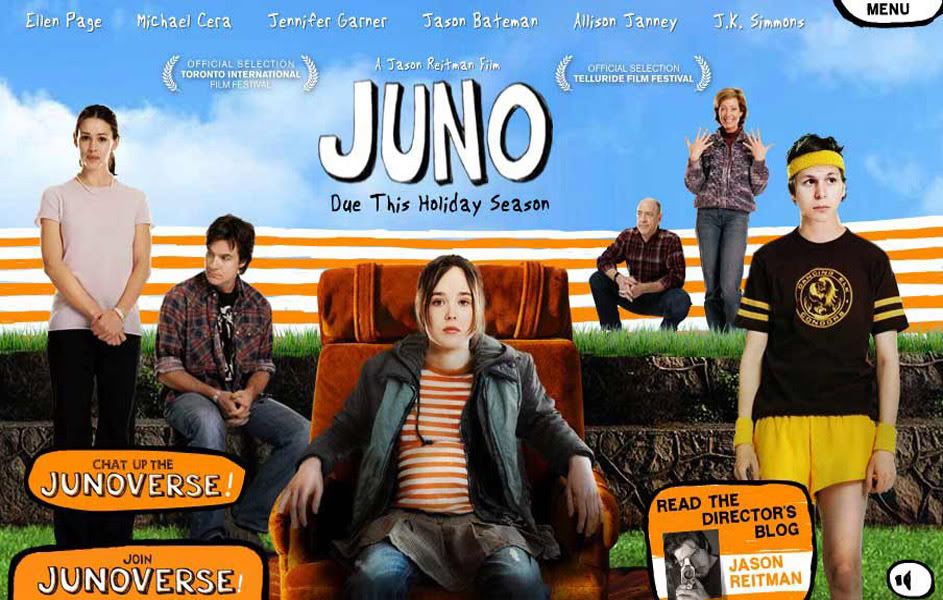
Independent Case Study: Juno (2007)


Over the next few weeks, I will be putting up case studies of Hollywood, Independent and British films to help my A level Film Studies students learn more about the finance, organisation, production, distribution and exhibition of different types of films.  These case studies can be used in their exam when discussing the American and British film industries. This is the third.  The first on Prometheus is here and the second on Attack the Block is here.

Director and writer:

Jason Reitman had only just completed directing Thank You for Smoking but as it was not released yet, he had difficulties acquiring the script for Juno.  He said it was ‘very hard... Thank You for Smoking had not come out yet, so I didn't have much going for me at the time. I was in the midst of finishing Thank You for Smoking, but I didn't have any street cred(ibility) yet’ http://www.movieweb.com/news/exclusive-director-jason-reitman-talks-juno

The script was also written by a first-timer, Diablo Cody.  ‘Before her screenwriting debut Juno received a rapturous standing ovation at this year's Toronto Film Festival, before Steven Spielberg called... Diablo Cody was giving halfhearted lap dances to greasy men at a Minneapolis strip club’ http://www.ew.com/ew/article/0,,20157948,00.html

‘When Jason Reitman, who'd made a name for himself with 2006's Thank You for Smoking, read the script for Juno, he scrapped plans to direct his own project to work with Cody instead. ''When I think of the response to Diablo and her screenplay,'' he says, ''the only person I can equate it to in recent history is Tarantino, that kind of overwhelming excitement about a fresh new voice.''’ http://www.ew.com/ew/article/0,,20157948_2,00.html

Independent film is where a huge amount of talent gets its big break.  Both Reitman and Cody have gone on to more commercial and bigger films since Juno, working with the likes of Clooney in Up in the Air and Megan Fox and Amanda Seyfried in Jennifer’s Body.  Only after Reitman’s first film was a success, did he get the job of directing this feature.  However there were still problems with funding.


Finance:

Budget: $7.5 million

‘There are a variety of methods and many different levels of independent film financing that can range from multi-million dollar backing from major studios right down to personal savings and credit cards of one individual’ http://www.makeindependentfilms.com/financing.htm

During promotion for the film, the actress playing Juno,  Ellen Page, said ‘I read the script a couple years ago -- it was one of those things that takes time [to get off the ground] -- and I fell in love then, but it kind of just dwindled away, didn't have money, so on and so forth. And then it came back around again, and I got excited all over again’ http://www.rottentomatoes.com/m/juno/news/1694026/ellen_page_on_juno_the_rt_interview/

‘the kind of movie Cody wanted to see initially scared off every major studio. ''A lot of people were worried that we would be protested by right-to-lifers or pro-choice people,'' says producer Lianne Halfon of an early incarnation of the project, which was ushered by her company Mr. Mudd... Even after Fox Searchlight greenlit the film, expectations were modest. ''We thought it was going to be a smaller movie because of the subject matter,'' says studio COO Nancy Utley’ http://www.ew.com/ew/article/0,,20175163_3,00.html

The production companies listed on IMDb that financed the film are:
Actor and producer John Malkovich
The involvement of Fox Searchlight demonstrates the modern trend of independent films being made by subsidiaries of the major Hollywood studios.  They take on more challenging and often more complex material but still desire to make profitable films and therefore hope for some mainstream success.  Juno, like so many other modern ‘independent’ films is actually not independent from the major studios and is therefore more independent in terms of its script, characters and story.  A film about a subject like teenage pregnancy is a concern for investors and so funding was hard to come by and expectations for the box office figures are kept low to ensure the film will be profitable.

Organisation:

As early as 1992, Hollywood majors were recognising that in order to capitalise on the potential mainstream success of independent films they needed not only to continue winning the distribution rights to unexpected, alternatively financed hits, but actively seek out the important directors with whom to collaborate. Sony Classics, Paramount Classics and Fox Searchlight were thus created by their respective, internationally co-owned, parent companies to deal with requests for funds. The result of such diversification was that, by the late-1990s, those 'independent' films and film producers winning plaudits were in fact conventionally financed, mainstream pictures; Boys Don't Cry and Election being funded and distributed by multinationals News Corporation and Viacom, with Miramax now a 'major independent' attached to the transglobal Disney corporation. With this, the criteria by which art-house films were marketed and exploited was also fundamentally changed. Higher budgets, increased advertising and wider platform releases all brought the 'independent' sector closer to the high stakes movie-making of the commercial cinema than ever beforehttp://www.thefilmjournal.com/issue6/americancinema.html

Today, every major film studio has specialty departments designed to create offbeat, smart contenders for the awards. They typically are films with modest budgets (usually less than $50 million) and limited promotion — at least initially.

In essence, such films are orchestrated to start off as word-of-mouth favorites among devoted moviegoers. As a result, they can wind up as Academy Award nominees with relatively few people having seen them’ http://www.usatoday.com/life/movies/movieawards/oscars/2008-02-21-oscar-box-office_N.htm

These quotes highlight the studios’ dominating of the independent sector in recent years.  They use their subsidiaries such as Fox Searchlight to make smaller films that can make big money thanks to festivals, competitions and awards.


Production:

‘Many independent producers don't watch the market for trends and analyze what movies they are competing with. They simply make a film and put it out. Studios have marketing departments and develop strategies for the best times to release a film’ http://voices.yahoo.com/analysis-2007-independent-film-box-office-numbers-1848390.html

‘To keep to the budget, high profile stars like Jennifer Garner took cuts in their usual pay’ http://www.cbsnews.com/stories/2008/02/09/sunday/main3812797.shtml

This happens a lot with independent films.  See also Pulp Fiction.
‘Reitman, whose wife, Michele Lee, is from Vancouver, specifically wanted to film here after having worked here on TV commercials, and not because he was told to for budgetary reasons’ http://www.canada.com/theprovince/news/etoday/story.html?id=4462e21d-ef83-4405-bc6a-e50cb1a578e5

"at the time there was a great deal of excitement about Jason Reitman. When we were just going into production he was being nominated for a Golden Globe. Lots of people were very interested in being a part of it. It was a very modest budget, so a lot of people were working for lower rates. Not low, but lower, and they had tight budget constraints and they did fantastic jobs." http://www.canada.com/reginaleaderpost/news/arts_life/story.html?k=11507&id=388a098f-854a-439f-a0c8-1c90da0eb7b0


Independent films typically have short shooting schedules and do not use the latest and most expensive technology such as CGI, Imax and 3D.  They do often feature stars but these stars often take pay cuts to appear in what they think will be critically adored and popular films.  It is shot on locations rather than in expensive studios with built sets.


Stars:

‘Ellen Page starred in the controversial film "Hard Candy" and appeared in "X-Men: The Last Stand". "Juno" is a reunion of sorts for Jason Bateman and Michael Cera, who both starred in the acclaimed Fox comedy "Arrested Development." Jennifer Garner starred on ABC's "Alias" and is known for such films as "13 Going on 30." Olivia Thirlby recently starred in David Gordon Green's Sundance hit "Snow Angels." JK Simmons played Nick Naylor's boss in Reitman's hit "Thank You for Smoking." Allison Janney starred on NBC's "The West Wing" and will soon be seen in the upcoming movie musical "Hairspray." Rainn Wilson plays Dwight on the NBC hit series "The Office."’ http://www.jeremywalker.com/pages/films/film_juno.htm#

‘On the teen appeal front, there’s Superbad‘s own supersensitive Michael Cera, presciently cast as the nominal male lead to the film’s obvious breakout star, Ellen Page (X-Men 3; Hard Candy)’ http://popwatch.ew.com/2007/09/04/telluride-day-4/

Lots of the stars here are famous from television and less so from feature films.  This can be typical of independent films that often do not have the budgets to afford the biggest stars.  However the stars they do get will help the film to cross over into the mainstream and be a draw for audiences to see the film.


Distribution:

‘A slow release (what most indies use) is to release on a limited number of screens in a few key markets and hope word of mouth drives up ticket sales. Then they will expand it (increase screen count) as ticket sales increase. The advantage is that it keeps P&A (prints and advertising) costs to a minimum’ http://voices.yahoo.com/analysis-2007-independent-film-box-office-numbers-1848390.html

The best movie of 2007 is coming to theatres 9 days earlier than expected. The film, Juno, directed by Jason Reitman was originally scheduled to hit theatres on December 15th, but has been moved up to take advantage of all the incredible advance buzz.  Juno will now hit theatres on Wednesday, December 5th in New York and Los Angeles, and will expand on a platform release in the subsequent weeks’ http://www.slashfilm.com/junos-due-date-sooner-than-expected/

"Juno" will open in an additional 13 cities on Friday, upping the total theatre count to about 40. Another 17 cities will be added on Dec. 21, and the film will further expand on Christmas Day before going nationwide Jan. 4’ http://www.variety.com/article/VR1117977409?refCatId=13

In the film, the protagonist Juno talks to her friend on a phone shaped like a hamburger. It’s a charming illustration of her quirky character, and there’s even a joke about it in the script.
The producers of Juno apparently sent a hamburger phone to journalists to entice them to review the film’ http://www.friendswithbenefitsbook.com/2008/01/27/great-movie-marketing-and-a-hamburger-phone-from-juno/

‘Paul de Carvalho, manager of Fox Searchlight in Australia, said the studio brought 100 Juno-branded phones to Australia for use in promotional giveaways’ http://www.theage.com.au/news/technology/junos-hamburger-phone-sparks-online-sales/2008/02/06/1202233932553.html

Distribution for this film is very different to most Hollywood blockbusters.  The film starts out at festivals and on a limited number of screens.  As buzz builds and word of mouth spreads, the film gets a wider release.  It is also released at a time when it is likely to get attention in the awards season.  The marketing is quirkier and less traditional than Hollywood blockbusters.  Note also that the posters and trailers emphasise the critical response to the film and the awards it has won.


Exhibition:

‘There are numerous reasons why indie films have small success. One of which is the number of screens they are released on. A typical studio wide release is 3000 plus screens. The Dark Knight was released on 4366 screens1. Most indie films are released with very small screen counts; many times only on 3 to 5 and sometimes a couple of hundred. If an indie gets a wide release it is usually because it already has some buzz. For instance Hostel 2 opened on 2350 screens but it was a sequel to a film that was a huge success’ http://voices.yahoo.com/analysis-2007-independent-film-box-office-numbers-1848390.html

‘In 2006 Little Miss Sunshine was opened on 7 screens in late July. Within 2 weeks it was expanded to 58 screens. Toward the end of August it began to get Oscar buzz and was expanded to 1602 screens. Of course Little Miss Sunshine went on to win 2 Oscars which helped its theatrical run that ended in March 2007. Although it is not typical for a small indie film ($8M budget) to do this well ($100M+ worldwide gross) it does happen using the slow release’ http://voices.yahoo.com/analysis-2007-independent-film-box-office-numbers-1848390.html

‘"Juno," playing in seven theaters in Los Angeles and Gotham, scored a boffo per-screen average of $60,016, one of the best on record for that number of theaters and outperforming the openings of previous Searchlight hits "Little Miss Sunshine" and "Sideways."’ http://www.variety.com/article/VR1117977409?refCatId=13

‘Fox Searchlight... recently made the decision to start rolling Reitman’s film out on December 14 — which, as screenwriter Diablo Cody ... says on her blog, "is not a messin’-around release date. It’s kind of a scary release date. It’s a we-believe-in-you release date”... The studio’s optimistic judgment call on that release date may not represent a sure Oscar-bait belief so much as an "everybody in the family over 15 will have a good time and go home hating each other less at Christmastime" kind of thing’ http://popwatch.ew.com/2007/09/04/telluride-day-4/

 ‘Juno has become a massive crossover hit, sailing past $100 million and landing Academy Award nominations for Best Picture, Best Actress, Best Director, and Best Original Screenplay. The Best Picture race may include such high-pedigree contenders as There Will Be Blood, Michael Clayton, No Country for Old Men, and Atonement, but little $6.5 million Juno has surpassed them all’ http://www.ew.com/ew/article/0,,20175163,00.html

Total Lifetime Grosses
Domestic:
 $143,495,265
   62.0%
 $87,916,319
   38.0%


Worldwide:
 $231,411,584


Juno has been incredibly successful for an independent film.  This is due to a clever script and great characters but also due to a clever distribution plan that has seen it embraced by a mainstream audience.

That's Juno in a nutshell and also hopefully a bit of insight into the state of modern American independent film.